Sappho Digital Ontology
Metadata
- IRI
-
https://w3id.org/sappho-digital/ontology/ - Title
-
Sappho Digital Ontology
- Creator
-
-
Laura Untner (https://orcid.org/0000-0002-9649-0870, laura.untner@fu-berlin.de)
-
- Version Info
-
Version 0.1
- Description
-
This is an ontology developed in the project Sappho Digital by Laura Untner. It reuses the Erlangen OWL version of the CIDOC Conceptual Reference Model (CRM; ECRM 240307, based on CIDOC CRM 7.1.3), the object-oriented version of IFLA’s Library Reference Model (LRMoo; v1.1.1) and INTRO (the Intertextual, Interpictorial and Intermedial Relations Ontology; beta202506) to model basic biographical and bibliographical as well as intertextual information.
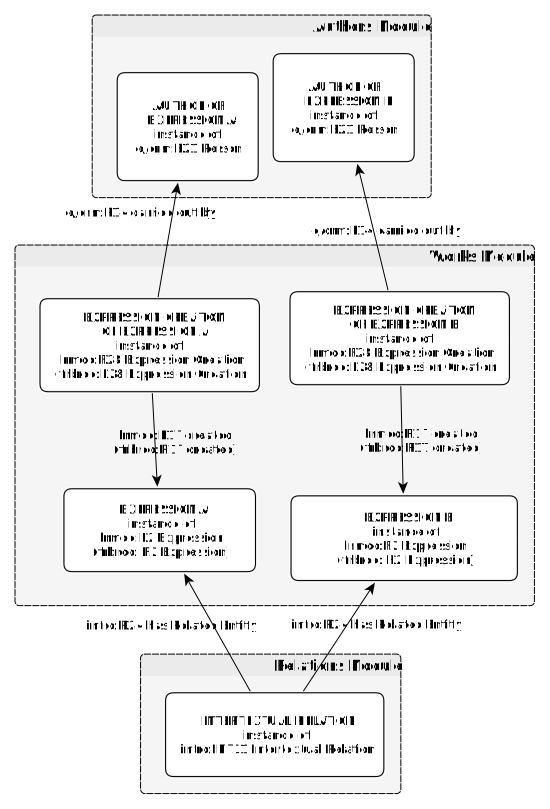
The ontology has three modules that are connected with each other, see figure 1:
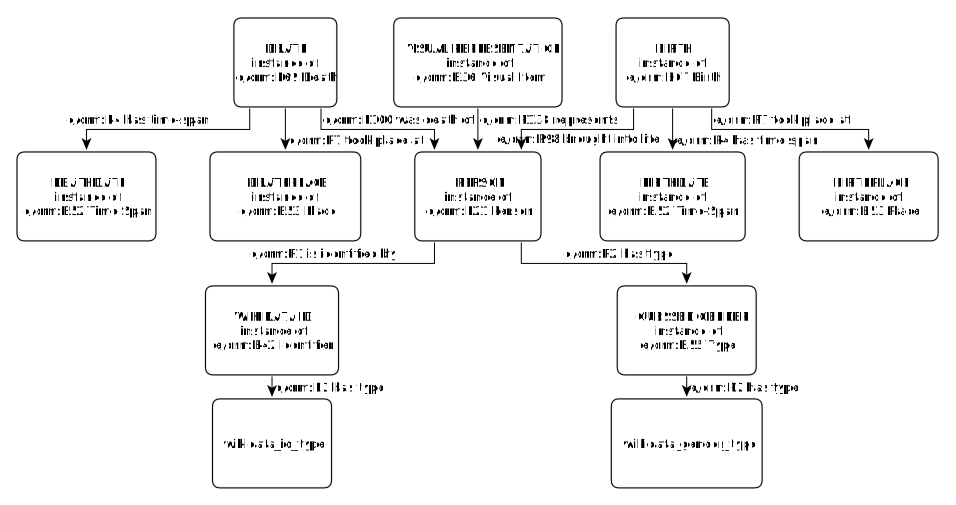
The authors module models basic bibliographic information, see figure 2:
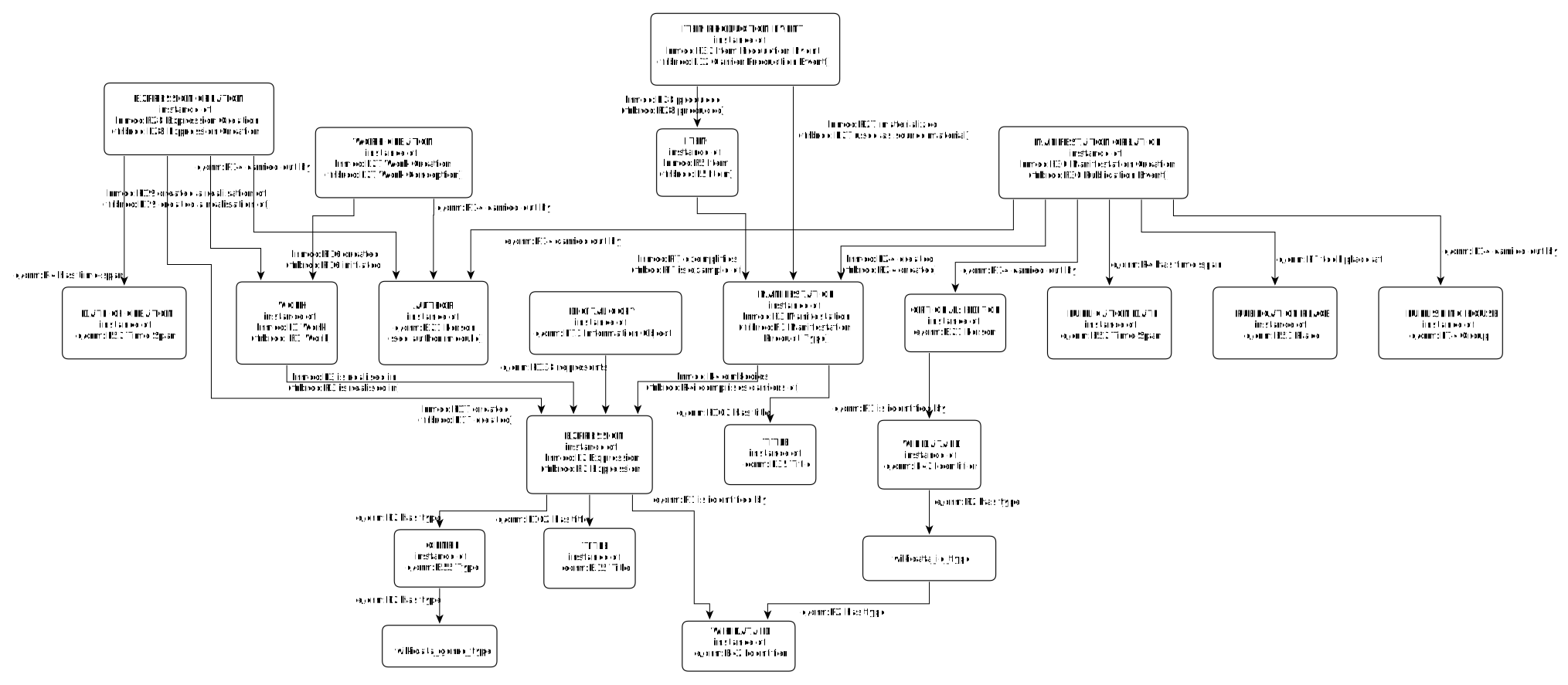
The works module models basic biographic information, see figure 3:
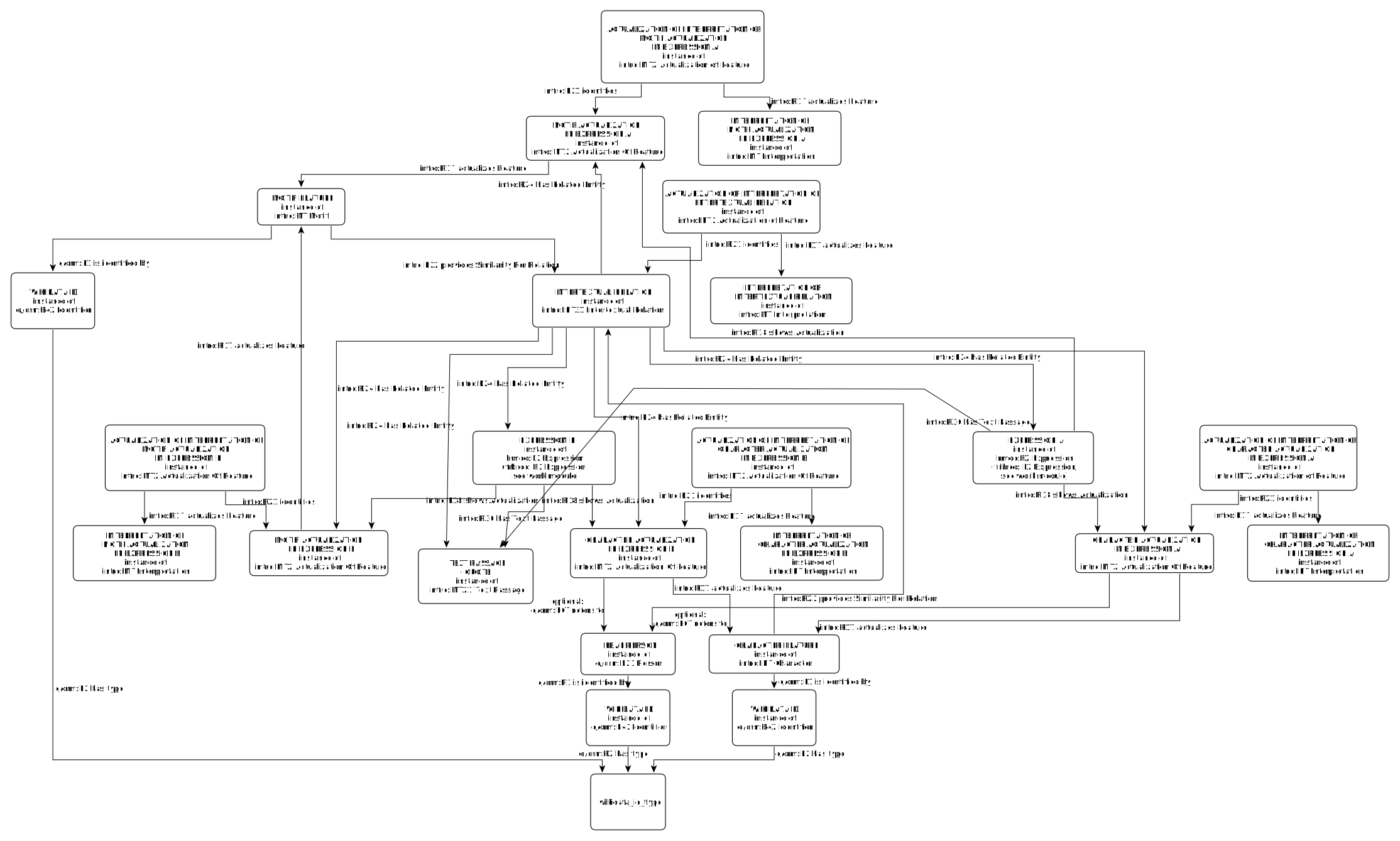
The relations module models intertextual information, see figure 4:
For alignments with the Bibliographic Ontology (BIBO), the FRBR-aligned Bibliographic Ontology (FaBiO), the Citation Typing Ontology (CiTO), Dublin Core (DC), the Document Components Ontology (DoCo), the DraCor Ontology, the Friends of a Friend (FOAF) Ontology, the Functional Requirements for Bibliographic Records object-oriented (FRBRoo) extension to the the CIDOC Conceptual Reference Model, the GOLEM Ontology for Narrative and Fiction, the Intertextuality Ontology, the Mining and Modeling Text (MiMoText) Ontology, the OntoPoetry/POSTDATA ontology (core and analysis modules), Schema.org, and the Ontologies of Under-Represented Writers and Books see the GitHub repository and the network visualization here.
Classes
E21 Person c
| IRI |
http://erlangen-crm.org/current/E21_Person
|
|---|---|
| Description |
Scope note: This class comprises real persons who live or are assumed to have lived. Legendary figures that may have existed, such as Ulysses and King Arthur, fall into this class if the documentation refers to them as historical figures. In cases where doubt exists as to whether several persons are in fact identical, multiple instances can be created and linked to indicate their relationship. The CIDOC CRM does not propose a specific form to support reasoning about possible identity. In a bibliographic context, a name presented following the conventions usually employed for personal names will be assumed to correspond to an actual real person (an instance of E21 Person), unless evidence is available to indicate that this is not the case. The fact that a persona may erroneously be classified as an instance of E21 Person does not imply that the concept comprises personae. Examples: - Tut-Ankh-Amun (Edwards and Boltin, 1979) - Nelson Mandela (Brown and Hort, 2006) In First Order Logic: - E21(x) ⇒ E20(x) - E21(x) ⇒ E39(x) |
| Sub Class Of | |
| In Domain Of |
|
| In Range Of | |
| Restriction |
|
E35 Title c
| IRI |
http://erlangen-crm.org/current/E35_Title
|
|---|---|
| Description |
Scope note: This class comprises the textual strings that within a cultural context can be clearly identified as titles due to their form. Being a subclass of E41 Appellation, E35 Title can only be used when such a string is actually used as a title of a work, such as a text, an artwork, or a piece of music. Titles are proper noun phrases or verbal phrases, and should not be confused with generic object names such as "chair", "painting", or "book" (the latter are common nouns that stand for instances of E55 Type). Titles may be assigned by the creator of the work itself, or by a social group. This class also comprises the translations of titles that are used as surrogates for the original titles in different social contexts. Examples: - "The Merchant of Venice" (McCullough, 2005) - "Mona Lisa" (Mohen, Menu and Mottin, 2006) - "La Pie" (Bortolatto, 1981) - "Lucy in the Sky with Diamonds" (Lennon, 1967) In First Order Logic: - E35(x) ⇒ E33(x) - E35(x) ⇒ E41(x) |
| Sub Class Of | |
| In Domain Of | P102 is title of op |
| In Range Of | P102 has title op |
E36 Visual Item c
| IRI |
http://erlangen-crm.org/current/E36_Visual_Item
|
|---|---|
| Description |
Scope note: This class comprises the intellectual or conceptual aspects of recognisable marks and images. This class does not intend to describe the idiosyncratic characteristics of an individual physical embodiment of a visual item, but the underlying prototype. For example, a mark such as the ICOM logo is generally considered to be the same logo when used on any number of publications. The size, orientation, and colour may change, but the logo remains uniquely identifiable. The same is true of images that are reproduced many times. This means that visual items are independent of their physical support. The E36 Visual Item class provides a means of identifying and linking together instances of E24 Physical Human-Made Thing that carry the same visual symbols, marks, or images, etc. The property P62 depicts (is depicted by) between E24 Physical Human-Made Thing and the depicted subjects (E1 CRM Entity) can be regarded as a shortcut of the more fully developed path from E24 Physical Human-Made Thing through P65 shows visual item (is shown by), E36 Visual Item, P138 represents (has representation) to E1 CRM Entity, which in addition captures the optical features of the depiction. Examples: - the visual appearance of Monet's "La Pie" (Bortolatto, 1981) - the Coca-Cola logo (E34) - the Chi-Rho (E37) - the communist red star (E37) - the surface shape of Auguste Rodin's statue "Le Penseur" [There exist more than 20 copies, even of different size. Therefore, this is a good example that it is only the common surface shape, an immaterial visual item, which justifies displaying these copies as works of Auguste Rodin. As usual practice, Rodin himself did not produce the bronze statue, but only the prototype model.] In First Order Logic: - E36(x) ⇒ E73(x) |
| Sub Class Of | E73 Information Object c |
| In Domain Of | P138 represents op |
| In Range Of | P138 has representation op |
E42 Identifier c
| IRI |
http://erlangen-crm.org/current/E42_Identifier
|
|---|---|
| Description |
Scope note: This class comprises strings or codes assigned to instances of E1 CRM Entity in order to identify them uniquely and permanently within the context of one or more organisations. Such codes are often known as inventory numbers, registration codes, etc. and are typically composed of alphanumeric sequences. Postal addresses, telephone numbers, URLs and e-mail addresses are characteristic examples of identifiers used by services transporting things between clients. The class E42 Identifier is not normally used for machine-generated identifiers used for automated processing unless these are also used by human agents. Examples: - "MM.GE.195" - "13.45.1976" - "OXCMS: 1997.4.1" (fictitious) - "ISSN 0041-5278" [Identifier for "The UNESCO Courier (Print)"] - ISRC "FIFIN8900186" [Identifier for : Kraft (29 min 14 s) / Magnus Lindberg, comp. ; Toimii Ensemble ; Swedish Radio symphony orchestra ; Esa-Pekka Salonen, dir.] - Shelf mark "Res 8 P 10" - "Guillaume de Machaut (1300?-1377)" [a controlled personal name heading that follows the French rules] (Reaney, 1974) - "+41 22 418 5571" - " weasel@paveprime.com" - "Rue David Dufour 5, CH-1211, Genève" - "1-29-3 Otsuka, Bunkyo-ku, Tokyo, 121, Japan" In First Order Logic: - E42(x) ⇒ E41(x) |
| Sub Class Of | ecrm:E41_Appellation |
E52 Time-Span c
| IRI |
http://erlangen-crm.org/current/E52_Time-Span
|
|---|---|
| Description |
Scope note: This class comprises abstract temporal extents, in the sense of Galilean physics, having a beginning, an end, and a duration. Instances of E52 Time-Span have no semantic connotations about phenomena happening within the temporal extent they represent. They do not convey any meaning other than a positioning on the "time-line" of chronology. The actual extent of an instance of E52 Time-Span can be approximated by properties of E52 Time-Span giving inner and outer bounds in the form of dates (instances of E61 Time Primitive). Comparing knowledge about time-spans is fundamental for chronological reasoning. Some instances of E52 Time-Span may be defined as the actual, in principle observable, temporal extent of instances of E2 Temporal Entity via the property P4 has time-span (is time-span of): E52 Time-Span. They constitute phenomenal time-spans as defined in CRMgeo (Doerr & Hiebel 2013). Since our knowledge of history is imperfect and physical phenomena are fuzzy in nature, the extent of phenomenal time-spans can only be described in approximation. An extreme case of approximation, might, for example, define an instance of E52 Time-Span having unknown beginning, end and duration. It may, nevertheless, be associated with other descriptions by which people can infer knowledge about it, such as in relative chronologies. Some instances of E52 may be defined precisely as representing a declaration of a temporal extent, as, for instance, done in a business contract. They constitute declarative time-spans as defined in CRMgeo (Doerr & Hiebel 2013) and can be described via the property E61 Time Primitive P170 defines time (time is defined by): E52 Time-Span. When used as a common E52 Time-Span for two events, it will nevertheless describe them as being simultaneous, even if nothing else is known. Examples: - 1961 - From 12-17-1993 to 12-8-1996 - 14h30 to 16h22 4(th) July 1945 - 9.30 am 1.1.1999 to 2.00 pm 1.1.1999 - the time-span of the Ming Dynasty (Chan, 2011) In First Order Logic: - E52(x) ⇒ E1(x) |
| Sub Class Of | ecrm:E1_CRM_Entity |
| In Domain Of | P4 is time-span of op |
| In Range Of | P4 has time-span op |
| Restriction |
P4 is time-span
of
op
some
ecrm:E2_Temporal_Entity
c
|
E53 Place c
| IRI |
http://erlangen-crm.org/current/E53_Place
|
|---|---|
| Description |
Scope note: This class comprises extents in the natural space where people live, in particular on the surface of the Earth, in the pure sense of physics: independent from temporal phenomena and matter. They may serve describing the physical location of things or phenomena or other areas of interest. Geometrically, instances of E53 Place constitute single contiguous areas or a finite aggregation of disjoint areas in space which are each individually contiguous. They may have fuzzy boundaries. The instances of E53 Place are usually determined by reference to the position of "immobile" objects such as buildings, cities, mountains, rivers, or dedicated geodetic marks, but may also be determined by reference to mobile objects. A Place can be determined by combining a frame of reference and a location with respect to this frame. It is sometimes argued that instances of E53 Place are best identified by global coordinates or absolute reference systems. However, relative references are often more relevant in the context of cultural documentation and tend to be more precise. In particular, people are often interested in position in relation to large, mobile objects, such as ships. For example, the Place at which Nelson died is known with reference to a large mobile object, i.e. H.M.S Victory. A resolution of this Place in terms of absolute coordinates would require knowledge of the movements of the vessel and the precise time of death, either of which may be revised, and the result would lack historical and cultural relevance. Any instance of E18 Physical Thing can serve as a frame of reference for an instance of E53 Place. This may be documented using the property P157 is at rest relative to (provides reference space for). Examples: - the extent of the UK in the year 2003 - the position of the hallmark on the inside of my wedding ring (fictitious) - the place referred to in the phrase: "Fish collected at three miles north of the confluence of the Arve and the Rhone" - here -> <- [the place between these two arrows in one of the reader's paper copy of this document. Each copy constitutes a different place of this spot.] In First Order Logic: - E53(x) ⇒ E1(x) |
| Sub Class Of | ecrm:E1_CRM_Entity |
| In Domain Of | P7 witnessed op |
| In Range Of | P7 took place at op |
| Restriction |
ecrm:P59i_is_located_on_or_within
max
1
|
E55 Type c
| IRI |
http://erlangen-crm.org/current/E55_Type
|
|---|---|
| Description |
Scope note: This class comprises concepts denoted by terms from thesauri and controlled vocabularies used to characterize and classify instances of CIDOC CRM classes. Instances of E55 Type represent concepts, in contrast to instances of E41 Appellation which are used to name instances of CIDOC CRM classes. E55 Type provides an interface to domain specific ontologies and thesauri. These can be represented in the CIDOC CRM as subclasses of E55 Type, forming hierarchies of terms, i.e. instances of E55 Type linked via P127 has broader term (has narrower term): E55 Type. Such hierarchies may be extended with additional properties. Examples: - weight, length, depth [types for instances of E54 Dimension] - portrait, sketch, animation [types for instances of E36 Visual Item] - French, English, German [types for instances of E56 Language] - excellent, good, poor [types for instances of E3 Condition State] - Ford Model T, chop stick [types for instances of E22 Human-Made Object] - cave, doline, scratch [types for instances of E26 Physical Feature] - poem, short story [types for instances of E33 Linguistic Object] - wedding, earthquake, skirmish [types for instances of E5 Event] In First Order Logic: - E55(x) ⇒ E28(x) |
| Sub Class Of | ecrm:E28_Conceptual_Object |
| In Domain Of | P2 is type of op |
| In Range Of | P2 has type op |
| Restriction |
ecrm:P135i_was_created_by
max
1
|
E67 Birth c
| IRI |
http://erlangen-crm.org/current/E67_Birth
|
|---|---|
| Description |
Scope note: This class comprises the births of human beings. E67 Birth is a biological event focussing on the context of people coming into life. (E63 Beginning of Existence comprises the coming into life of any living being.) Twins, triplets, etc. are brought into life by the same instance of E67 Birth. The introduction of the E67 Birth event as a documentation element allows the description of a range of family relationships in a simple model. Suitable extensions may describe more details and the complexity of motherhood since the advent of modern medicine. In this model, the biological father is not seen as a necessary participant in the E67 Birth. Examples: - the birth of Alexander the Great (Stoneman, 2004) In First Order Logic: - E67(x) ⇒ E63(x) |
| Sub Class Of | ecrm:E63_Beginning_of_Existence |
| In Domain Of | P98 brought into life op |
| In Range Of | P98 was born op |
| Restriction |
|
E69 Death c
| IRI |
http://erlangen-crm.org/current/E69_Death
|
|---|---|
| Description |
Scope note: This class comprises the deaths of human beings. If a person is killed, their death should be instantiated as E69 Death and as E7 Activity. The death or perishing of other living beings should be documented as instances of E64 End of Existence. Examples: - the murder of Julius Caesar (E69, E7) (Irwin, 1935) - the death of Senator Paul Wellstone (Monast and Tao, 2002) In First Order Logic: - E69(x) ⇒ E64(x) |
| Sub Class Of | ecrm:E64_End_of_Existence |
| In Domain Of | P100 was death of op |
| In Range Of | P100 died in op |
| Restriction |
P100 was death
of
op
some
E21 Person
c
|
E73 Information Object c
| IRI |
http://erlangen-crm.org/current/E73_Information_Object
|
|---|---|
| Description |
Scope note: This class comprises identifiable immaterial items, such as poems, jokes, data sets, images, texts, multimedia objects, procedural prescriptions, computer program code, algorithm or mathematical formulae, that have an objectively recognizable structure and are documented as single units. The encoding structure known as a "named graph" also falls under this class, so that each "named graph" is an instance of E73 Information Object. An instance of E73 Information Object does not depend on a specific physical carrier, which can include human memory, and it can exist on one or more carriers simultaneously. Instances of E73 Information Object of a linguistic nature should be declared as instances of the E33 Linguistic Object subclass. Instances of E73 Information Object of a documentary nature should be declared as instances of the E31 Document subclass. Conceptual items such as types and classes are not instances of E73 Information Object, nor are ideas without a reproducible expression. Examples: - image BM000038850.JPG from the Clayton Herbarium in London (E31) (Natural History Museum, 2021) - E. A. Poe's "The Raven" (Poe, 1869) - the movie "The Seven Samurai" by Akira Kurosawa (Mellen, 2002) - the text of Huray describing the Maxwell Equations (Huray, 2010) - the Getty AAT as published as Linked Open Data, accessed 1/10/2014 In First Order Logic: - E73(x) ⇒ E89(x) - E73(x) ⇒ E90(x) |
| Sub Class Of | |
| In Domain Of | P165 incorporates op |
| In Range Of | P165 is incorporated in op |
| Super Class Of | E36 Visual Item c |
E74 Group c
| IRI |
http://erlangen-crm.org/current/E74_Group
|
|---|---|
| Description |
Scope note: This class comprises any gatherings or organizations of human individuals or groups that act collectively or in a similar way due to any form of unifying relationship. In the wider sense this class also comprises official positions which used to be regarded in certain contexts as one actor, independent of the current holder of the office, such as the president of a country. In such cases, it may happen that the group never had more than one member. A joint pseudonym (i.e. a name that seems indicative of an individual but that is actually used as a persona by two or more people) is a particular case of E74 Group. A gathering of people becomes an instance of E74 Group when it exhibits organizational characteristics usually typified by a set of ideas or beliefs held in common, or actions performed together. These might be communication, creating some common artifact, a common purpose such as study, worship, business, sports, etc. Nationality can be modelled as membership in an instance of E74 Group. Married couples and other concepts of family are regarded as particular examples of E74 Group. Examples: - the Impressionists (Wilson, 1994) - the Navajo (Correll, 1972) - the Greeks (Williams, 1993) - the peace protestors in New York City on 15(th) February 2003 - Exxon-Mobil (Raymond, 2006) - King Solomon and his wives (Thieberger, 1947) - the President of the Swiss Confederation - Nicolas Bourbaki [the collective pseudonym of a group of mathematicians, predominantly French alumni of the École normale supérieure] (Aczel, 2007) - Betty Crocker (Crocker, 2012) - Ellery Queen [Ellery Queen is a pseudonym created in 1929 by American crime fiction writers Frederic Dannay and Manfred Bennington Lee.] (Wheat, 2005) - Greenpeace - Paveprime Ltd - the National Museum of Denmark In First Order Logic: - E74(x) ⇒ E39(x) |
| Sub Class Of | ecrm:E39_Actor |
| Restriction |
E90 Symbolic Object c
| IRI |
http://erlangen-crm.org/current/E90_Symbolic_Object
|
|---|---|
| Description |
Scope note: This class comprises identifiable symbols and any aggregation of symbols, such as characters, identifiers, traffic signs, emblems, texts, data sets, images, musical scores, multimedia objects, computer program code, or mathematical formulae that have an objectively recognizable structure and that are documented as single units. It includes sets of signs of any nature, which may serve to designate something, or to communicate some propositional content. An instance of E90 Symbolic Object may or may not have a specific meaning, for example an arbitrary character string. In some cases, the content of an instance of E90 Symbolic Object may completely be represented by a serialized digital content model, such as a sequence of ASCII-encoded characters, an XML or HTML document, or a TIFF image. The property P3 has note and its subproperty P190 has symbolic content allow for the description of this content model. In order to disambiguate which symbolic level is the carrier of the meaning, the property P3.1 has type can be used to specify the encoding (e.g. "bit", "Latin character", RGB pixel). Examples: - 'ecognizabl' - the "no-smoking" sign (E36) - "BM000038850.JPG" (E41) [identifies a digital image] (Natural History Museum, 2021) - image BM000038850.JPG from the Clayton Herbarium in London (E36) [depicts specimen of Verbesina virginica] (Natural History Museum, 2021) - the distribution of form, tone and colour found on Leonardo da Vinci's painting named "Mona Lisa" in daylight (E36) - the Italian text of Dante's "Divina Commedia" as found in the authoritative critical edition "La Commedia secondo l'antica vulgata a cura di Giorgio Petrocchi" (E33) (Petrocchi, 1967) In First Order Logic: - E90(x) ⇒ E28(x) - E90(x) ⇒ E72(x) |
| Sub Class Of | |
| In Domain Of | P165 is incorporated in op |
| In Range Of | P165 incorporates op |
| Restriction |
ecrm:P106_is_composed_of
some
E90 Symbolic
Object
c
|
| Super Class Of | E73 Information Object c |
F1 Work c
| IRI |
http://iflastandards.info/ns/lrm/lrmoo/F1_Work
|
|---|---|
| Description |
Scope note: This class comprises distinct intellectual ideas conveyed in artistic and intellectual creations, such a poems, stories or musical compositions. A Work is the outcome of an intellectual process of one or more persons. Inherent to the notion of work is the existence of recognisable realizations of the work in the form of one or more expressions. Works are often regarded as finished and discrete e.g. when declared as such by the creator of the work or based on the elaboration or logical coherence of its content. However, works may be recognized as existing but unfinished e.g. if the creators deliberately or accidentally never explicitly finished a particular Expression but have left behind partial expressions. In the absence of explicit information about the initial conception, which is rarely available, the first expression created constitutes witness of the beginning of existence of a Work. A Work can evolve over time, such as through revised editions. A Work may be elaborated by one or more Actors simultaneously, in parallel, or over time. Additional expressions of a Work can continue to be created over time. The boundaries of a Work have nothing to do with the value of the intellectual achievement but only with the dominance of a concept. The main purpose of this class is to enable bringing together intellectually equivalent Expressions in order to display to a user all available alternatives of the same intellectual or artistic content. Examples: - Agatha Christie's 'Murder on the Orient Express' [novel] - Mary Shelley's 'Frankenstein, or, The Modern Prometheus' [novel] - Ursula K. Le Guin's 'The Earthsea trilogy' [set of novels] - Ursula K. Le Guin's 'The Tombs of Atuan' [novel which is part of 'The Earthsea trilogy'] - Homer's 'Odyssey' [ancient Greek epic poem] - Dante's 'Divina Commedia' [narrative poem] - William Shakespeare's 'The Tragedy of Hamlet, Prince of Denmark' [play] - Henry Gray's 'Anatomy of the human body' [scholarly work / reference work] - René Goscinny and Albert Uderzo's 'Astérix le Gaulois' [cartoon] - the 'Dewey Decimal Classification' (DDC) [library classification system] - the Ordnance Survey's 1:50 000 'Landranger series' [collection of maps] - Ludwig van Beethoven's 'Symphony No. 9 in D minor' [symphony] - Johann Sebastian Bach's 'Goldberg Variations' [compositions for keyboard] - Daniel Humair and Damien Varaillon's 'Hommage à John Coltrane' [musical improvisation] - John Lennon and Paul McCartney's 'I want to hold your hand' [song] - François Truffault's 'Jules et Jim' [movie] - Alfred Hitchcock's 'Psycho' [movie] - Auguste Rodin's 'Le penseur' ('The thinker') [art] - Pablo Picasso's 'Guernica' [art] - Katsushika Hokusai's '神奈川沖浪裏' ('The Great Wave') [art] In First Order Logic: - F1(x) ⇒ E89(x) |
| Sub Class Of | cidoc:E89_Propositional_Object |
| In Domain Of | |
| In Range Of |
|
F27 Work Creation c
| IRI |
http://iflastandards.info/ns/lrm/lrmoo/F27_Work_Creation
|
|---|---|
| Description |
Scope note: This class comprises activities by which instances of F1 Work come into existence. An instance of F27 Work Creation can serve to document the period a work was coming into existence and the circumstances of it, when these are known. An instance of F27 Work Creation marks the initial creation of an instance of F1 Work through expressions or other externalisations that are sufficiently elaborated so that the characteristic conceptual identity of the work could be recognized as existing. In many cases this will coincide with the first known complete externalisation of an expression of the work. In other cases, the initial creation of an instance of F1 Work may be inferred from multiple, or later, expressions or other forms of evidence. For instance, commissioning of a work may explicitly be agreed on after the presentation of an already complete and detailed elaboration of the work that was not made public. Performances may be prior to written expressions, as in the case of Shakespeare's works. The work, as an intellectual construction, may evolve from its initial creation onwards, until the last known expression of it. An instance of E39 Actor with which a work is associated through the chain of properties F1 Work. R16i was created by: F27 Work Creation. P14 carried out by (performed): E39 Actor corresponds to the notion of the "creator" of the work. In the situation where an expression of one instance of F1 Work serves as source material for the creation of the first expression of a new instance of F1 Work, the direct relationship between the works is indicated using the property R2 is derivative of (has derivative) between the two instances of F1 Work. The link to the specific source expression is indicated with the property P16 used specific object (was used for) using the path: F1 Work(1). R3 is realised in: F2 Expression(1). P16i was used for: F27 Work Creation. R16 created: F1 Work(2). Examples: - Agatha Christie creating 'Murder on the Orient Express' - Mary Shelley creating 'Frankenstein, or, The Modern Prometheus' - Dante creating the poem 'Divina Commedia' - William Shakespeare creating 'The Tragedy of Hamlet, Prince of Denmark' - René Goscinny and Albert Uderzo (collaboratively) creating 'Astérix le Gaulois' - Ludwig van Beethoven composing his Symphony No. 9 - Johann Sebastian Bach composing the 'Goldberg Variations' - the making of 'Jules et Jim', directed by François Truffault - the making of 'Psycho', directed by Alfred Hitchcock - Auguste Rodin creating 'Le Penseur' ('The Thinker') - Picasso creating 'Guernica' - Pascal Bonnefois and Marie-Louise Ollier creating 'Yvain ou Le chevalier au lion : concordance lemmatisée' [a concordance for the novel 'Le chevalier au lion' by Chrétien de Troyes, based on the 1960 edition by Mario Roques] In First Order Logic: - F27(x) ⇒ E65(x) |
| Sub Class Of | cidoc:E65_Creation |
| In Domain Of | R16 created op |
| In Range Of | R16i was created by op |
F28 Expression Creation c
| IRI |
http://iflastandards.info/ns/lrm/lrmoo/F28_Expression_Creation
|
|---|---|
| Description |
Scope note: This class comprises activities that result in instances of F2 Expression coming into existence. An instance of F2 Expression is considered to be created when it is captured on a carrier other than the creator's brain. Although F2 Expression is an abstract entity, a conceptual object, the creation of an expression inevitably also affects the physical world: when you scribble the first draft of a poem on a sheet of paper, you produce an instance of F3 Manifestation and an instance of F5 Item. F28 Expression Creation is a subclass of E12 Production because the recording of the expression causes a physical modification of the E18 Physical Thing that serves as the carrier. The creation of an instance of F2 Expression coincides with the creation of the first instance of F3 Manifestation that R4 embodies (is embodied in) this instance of F2 Expression. The P2 has type (is type of) property can be used to specify the type of the instance of F28 Expression Creation (i.e., activities such as translating, revising, or arranging music are types of creation process). The type of the process is distinct from the type of result even though the typology frequently used for instances of the resulting F2 Expressions may imply the category of the instance of the F28 Expression Creation. An instance of F28 Expression Creation may use as source material one or more specific instances of F2 Expression. When the source expression is documented this is also expressed by the property R76 is derivative of (has derivative). Examples: - Agatha Christie writing the original manuscript for 'Murder on the Orient Express' - Elisabeth van Bebber creating the German translation of 'Murder on the Orient Express' - Angela Hewitt performing the 'Goldberg Variations' at St. Thomas Church (Leipzig Germany) in November 2020 - Angela Hewitt performing the 'Goldberg Variations' in Christuskirche (Berlin) on 14-17 December 2015 (for a CD production) - Beethoven scripting the original score for the 9(th) symphony - Jonathan Del Mar editing and creating the score for Beethoven's 9(th) symphony (as published by Bärenreiter in 1997) - the making of the original cut of Hitchcock's movie 'Psycho' - the making of the censored version of Hitchcock's movie 'Psycho' that was released in Britain - Auguste Rodin making the first plaster version of 'The Thinker' sculpture - the making of the large-scale version of 'The Thinker' by the 'Fonderie Alexis Rudier in 1904 In First Order Logic: - F28(x) ⇒ E12(x) - F28(x) ⇒ E65(x) |
| Sub Class Of | |
| In Domain Of | R17 created op |
| In Range Of | R17i was created by op |
F2 Expression c
| IRI |
http://iflastandards.info/ns/lrm/lrmoo/F2_Expression
|
|---|---|
| Description |
Scope note: This class comprises the intellectual or artistic realisations of Works in the form of identifiable immaterial objects, such as texts, poems, jokes, musical or choreographic notations, movement pattern, sound pattern, images, multimedia objects, or any combination of such forms. The substance of F2 Expression is signs. An Expression is the outcome of the intellectual or creative process of realizing a Work. Subsequent expressions conveying the same work may be created over time. Expressions do not depend on a specific physical carrier and can exist on one or more carriers simultaneously. As far as bibliographic practice is concerned, only instances of F2 Expression that are externalised on physical carriers other than both the creator's brain and an auditor's brain are taken into account. The form of F2 Expression is an inherent characteristic of the F2 Expression. Differences in form imply different Expressions (e.g., from text to spoken word, a transcript of a recording). Similarly, differences in language or means of performance imply different Expressions (e.g., translations or arrangements for different instruments). Thus, if a text is revised or modified, the result is considered to be a new F2 Expression. While theoretically any change in signs will result in a new Expression, conventionally the context and use will determine the rules for distinguishing among expressions. An instance of F2 Expression which includes spoken or written text may be multiply instantiated as an instance of E33 Linguistic Object. This allows for the association of the E56 Language of the text with the instance of F2 Expression by using the property P72 has language (is language of). Examples: - the original text (in English) by Agatha Christie for her novel 'Murder on the Orient Express' - the German text of 'Murder on the Orient Express' (as translated by Elisabeth van Bebber and published with the title 'Mord im Orientexpress') - the text of the abridged English version of 'Murder on the Orient Express' (as published by HarperCollins) - the narrated English text of 'Murder on the Orient Express' by David Suchet - the English text of Homer's 'Odyssey' translated by Robert Fagles - the English text of Homer's 'Odyssey' translated by Richmond Lattimore - 'Dewey Decimal Classification', 23rd edition (DDC23) [English edition] - 'Classification décimale de Dewey', 23e édition [French translation of DDC23] - the performance of Bach's 'Goldberg Variations' by Angela Hewitt at St. Thomas Church (Leipzig Germany) in November 2020 - the performance of Bach's 'Goldberg Variations' by Angela Hewitt in Christuskirche (Berlin) on 14-17 December 2015 - the musical score for Bach's 'Goldberg Variations' (as published by Balthasar Schmid in 1741) - Beethoven's original score for Symphony No. 9 (as expressed by Beethoven's original hand-written manuscript held by the Berlin State Library) - the score for Beethoven's Symphony No. 9 that was edited by Jonathan Del Mar and published by Bärenreiter in 1997 - the original cut of Hitchcock's movie 'Psycho' - the censored version of Hitchcock's movie 'Psycho' that was released in Britain (with stabbing sounds and visible nude shots removed) - the first plaster version of 'The Thinker' sculpture made by Auguste Rodin around 1881 - large scale version of Auguste Rodin's 'The Thinker' created at the Fonderie Alexis Rudier in 1904 In First Order Logic: - F2(x) ⇒ E73(x) |
| Sub Class Of | cidoc:E73_Information_Object |
| In Domain Of | |
| In Range Of |
F30 Manifestation Creation c
| IRI |
http://iflastandards.info/ns/lrm/lrmoo/F30_Manifestation_Creation
|
|---|---|
| Description |
Scope note: This class comprises the activities of selecting, arranging and presenting one or more instances of F2 Expression on a carrier or other persistent presentation means with the purpose of communicating it to some public. It includes the specification of the presentation as to sensory impression (such as visual appearance or audio rendition). Examples: - the process of creating the publication 'Murder on the Orient Express / Agatha Christie', published by HarperCollins in 2017, including deciding the format, typesetting the text, designing the cover and other features of the publication - the process of making the HTML-version of the English text of Homer's 'Odyssey' (translated by S. H. Butcher and A. Lang), which is available online from the Gutenberg Project - the process of making the engraved copper plates for the first edition of Bach's 'Goldberg Variations' by Balthasar Schmid - the process of making the CD publication 'Bach Goldberg Variations', published by Hyperion Records in 2016, including the process of recording the performance, editing, and typesetting the booklet, and design of the overall publication In First Order Logic: - F30(x) ⇒ E12(x) - F30(x) ⇒ E65(x) |
| Sub Class Of | |
| In Domain Of | R24 created op |
| In Range Of | R24i was created through op |
F3 Manifestation c
| IRI |
http://iflastandards.info/ns/lrm/lrmoo/F3_Manifestation
|
|---|---|
| Description |
Scope note: This class comprises products rendering one or more Expressions. A Manifestation is defined by both the overall content and the form of its presentation. The substance of F3 Manifestation is not only signs, but also the manner in which they are presented to be consumed by users, including the kind of media adopted. An F3 Manifestation is the outcome of a publication process where one or more F2 Expressions are prepared for public dissemination, but it may also be a unique form created directly on some material carrier without the intent of being formally published. An instance of F3 Manifestation typically incorporates one or more instances of F2 Expression representing a distinct logical content and all additional input by a publisher such as text layout and cover design. Additionally an F3 Manifestation can be identified by the physical features for the medium of distribution, if applicable. For example, publications in the form of hard-cover and paperback editions would be two distinct instances of F3 Manifestation, even though authorial and editorial content are otherwise identical in both publications. In the case of industrial products such as printed books or music CDs, but also digital material, an instance of F3 Manifestation can be regarded as the prototype for all copies of it. In these cases, an instance of F3 Manifestation specifies all of the features or traits that instances of F5 Item display in order to be copies of a particular publication. In the case of industrial products, instances of F3 Manifestation are also instances of E99 Product Type, normally nowadays identified by characteristic identifiers such as ISBN numbers. Examples: - the publication 'Murder on the Orient Express / Agatha Christie', published by Collins Crime Club in 1934 - the publication of 'Murder on the Orient Express / Agatha Christie', published by HarperCollins in 2017 - the publication 'Mord im Orientexpress : ein Hercule-Poirot-Roman / Agatha Christie', published by Deutscher Bücherbund in 1975 - the publication 'Murder on The Orient Express / Agatha Christie', narrated by David Suchet, audio book (audio CD) published by HarperCollins in 2005 - the HTML-version of Homer's 'Odyssey' with English text by S. H. Butcher and A. Lang, available online from the Gutenberg Project - the publication 'The Illustrated Odyssey', published by Sidgwick & Jackson Ltd in 1980, containing the translated text by E.V. Rieu, an introduction by Jacquetta Hawkes and photographs by Tim Mercer - the publication 'The Odyssey of Homer' published by Harper & Row in 1967, containing an introduction and the English translation of the Greek poem by Richmond Lattimore - the CD publication 'Bach Goldberg Variations', published by Hyperion Records in 2016, containing a CD with Angela Hewitt's performances of Bach's 'Goldberg Variations' recorded in Christuskirche (Berlin) on 14-17 December 2015 and a booklet with an introduction to the music by Angela Hewitt in English, French and German - the manuscript known as 'The Book of Kells' - the publication containing a text entitled 'Pop Culture' (authored by a person named 'Richard Memeteau'), issued in 2014 by the publisher named 'Zones' and distributed in EPUB2 format by a distributor named 'Editis' and identified by ISBN '978-2-35522-085-2' - the publication entitled 'Alfred Hitchcock's Psycho: 60th Anniversary Edition', containing one Blu-ray disc with two cuts of the movie, released in 2020 In First Order Logic: - F3(x) ⇒ E73(x) |
| Sub Class Of | cidoc:E73_Information_Object |
| In Domain Of | |
| In Range Of |
INT18 Reference c
| IRI |
https://w3id.org/lso/intro/currentbeta#INT18_Reference
|
|---|---|
| Description |
This class comprises references to – usually: real – identifiable objects of any kind. It is not restricted to non-fictional texts resp. images depicting real life objects or events, but can be most easily applied there. The CIDOC CRM property P67 refers to is recommended to establish the link to the referred to entity. There are two options with slightly different semantic and alignment implications: P67 refers to can link this INT18 Reference (or any other feature) to the external entity, which would make the INT18 Reference an E89 Propositional Object (due to P67's domain and range). However, this is in conflict with the conceptual similarity of the F4 Feature and its subclasses to CIDOC CRM's E55 Type. INTRO's suggested – but in no way prescribed – solution is to instead attach P67 refers to to the INT2 Actualization of Feature linked to INT18 Reference. The scope of this class also includes references to other images/texts, if one wants to model an interrelation this way. |
| Sub Class Of |
INT21 Text Passage c
| IRI |
https://w3id.org/lso/intro/currentbeta#INT21_TextPassage
|
|---|---|
| Description |
The INT21 TextPassage is a means of modelling an identifiable part of an E73 Information Object or its subclasses – without that part being removed from its source Information Object. Examples: – The words 'Abandon all hope ye who enter here' from Canto III of Dante's Inferno. – The first four lines of Rilke's poem "Archaischer Torso Apollos" – The last item on a shopping list. The skos:broadMatch states that the INT21 TextPassage can be regarded as an oa:SpecificResource in the sense that it is a section of a resource. The skos:broadMatch between R41 hasLocation and oa:hasSelector indicates that by replacing R41 hasLocation with oa:hasSelector, multiple selector options from the Web Annotation Ontology can be utilized to specify the INT21 TextPassage's location. |
| Sub Class Of | intro:INT1_Passage |
| In Domain Of | |
| In Range Of |
INT2 Actualization of Feature c
| IRI |
https://w3id.org/lso/intro/currentbeta#INT2_ActualizationOfFeature
|
|---|---|
| Description |
The fact that a text or an image shows – in its own specific way – a certain feature (which itself is an abstract concept and takes form in many texts/images), e. g., a motif, an atmosphere, a theme, a figure of speech. Examples: – the specific actualization of the motif of patricide in Sophokles' "Ödipus Rex". – the specific actualization of the Faust-subject in Goethe's "Faust". – the specific actualization of the iambic pentameter in Rilke's "Archaischer Torso Apollos". – the specific actualization of the Ophelia-character in John Everett Millais' painting "Ophelia". Notes: The INT2 Actualization of Feature can be subject to a I2 Belief as modelled in CRMinf, used like the CRMinf class I4 Proposition Set. |
| Sub Class Of | cidoc:E28_Conceptual_Object |
| In Domain Of | |
| In Range Of |
INT31 Intertextual Relation c
| IRI |
https://w3id.org/lso/intro/currentbeta#INT31_IntertextualRelation
|
|---|---|
| Description |
This class comprises the abstract notion of a relationship between texts resp. parts thereof. It is not identical to, e. g., a quote, but a quote can be considered a typical case. However, the class does not demand any specific theoretical prerequisites for the relation (like the author's intention, identical wording, etc.), but encompasses relations based on all kinds of theoretical frameworks, including scholarly ('pastiche'), legal ('plagiarism'), or very general notions ('quote', 'allusion'). Every INT31 Intertextual Relation has at least two related entities, which are modelled as texts (on any ontological level, including parts thereof) or INT2 Actualizations of Features on these texts. An INT3 Interrelation is possibly identified in an INT2 Actualization of an INT Interpretation and further defined by an INT11 TypeOfInterrelation, or maybe, more precisely, an INT15 Intertextuality in Intertextuality Theories. The skos:broadMatch to oa:Annotation indicates that stating the existence of an intertextual relation can be seen as a kind of annotation made to resources, in this case: at least two, the related entities texts (on any ontological level, including parts thereof). |
| Sub Class Of | intro:INT3_Interrelation |
INT Character c
| IRI |
https://w3id.org/lso/intro/currentbeta#INT_Character
|
|---|---|
| Sub Class Of | intro:INT9_SemanticFeature |
INT Interpretation c
| IRI |
https://w3id.org/lso/intro/currentbeta#INT_Interpretation
|
|---|---|
| Description |
The result of a interpretative act, possibly: as perceived in research literature. An interpretation can identify references or actualizations or the like. A number of interpretations can together recreate the structure of, e. g., a research paper. Accordingly, apart from linking INT Interpretations to the subjects of the interpretation, like intertextual relations or textual features, they can be linked to each other via R9 has subsequent feature resp. R9i has preceding feature. Examples: – the statement that Umberto Eco's 'The Name of the Rose' features a detective character. – the statement that Umberto Eco's 'The Name of the Rose' contains references to Arthur Conan Doyle's 'Sherlock Holmes'. – the statement that Umberto Eco's 'The Name of the Rose' is set in the 14th century. – the conclusion that Umberto Eco's 'The Name of the Rose' belongs to the genre 'postmodern crime novel'. |
| Sub Class Of |
INT Motif c
| IRI |
https://w3id.org/lso/intro/currentbeta#INT_Motif
|
|---|---|
| Sub Class Of | intro:INT9_SemanticFeature |
INT Plot c
| IRI |
https://w3id.org/lso/intro/currentbeta#INT_Plot
|
|---|---|
| Sub Class Of | intro:INT9_SemanticFeature |
INT Topic c
| IRI |
https://w3id.org/lso/intro/currentbeta#INT_Topic
|
|---|---|
| Sub Class Of | intro:INT9_SemanticFeature |
| In Range Of | about op |
INT Topos c
| IRI |
https://w3id.org/lso/intro/currentbeta#INT_Topos
|
|---|---|
| Sub Class Of | intro:INT9_SemanticFeature |
| In Range Of | about op |
Object Properties
P100 was death of op
| IRI |
http://erlangen-crm.org/current/P100_was_death_of
|
|---|---|
| Description |
Quantification: one to many, necessary (1,n:0,1) Scope note: This property links an instance of E69 Death to the instance of E21 Person that died. An instance of E69 Death may involve multiple people, for example in the case of a battle or disaster. This is not intended for use with general natural history material, only people. Examples: - Mozart's death (E69) was death of Mozart (E21). (Sitwell, 2017) In First Order Logic: - P100(x,y) ⇒ E69(x) - P100(x,y) ⇒ E21(y) - P100(x,y) ⇒ P93(x,y) |
| Sub Property Of | ecrm:P93_took_out_of_existence |
| Domain | E69 Death c |
| Range | E21 Person c |
P100 died in op
| IRI |
http://erlangen-crm.org/current/P100i_died_in
|
|---|---|
| Description |
Quantification of the inverse property: one to many, necessary (1,n:0,1) Scope note of the inverse property: This property links an instance of E69 Death to the instance of E21 Person that died. An instance of E69 Death may involve multiple people, for example in the case of a battle or disaster. This is not intended for use with general natural history material, only people. Examples of the inverse property: - Mozart's death (E69) was death of Mozart (E21). (Sitwell, 2017) In First Order Logic of the inverse property: - P100(x,y) ⇒ E69(x) - P100(x,y) ⇒ E21(y) - P100(x,y) ⇒ P93(x,y) |
| Sub Property Of | ecrm:P93i_was_taken_out_of_existence_by |
| Domain | E21 Person c |
| Range | E69 Death c |
P102 has title op
| IRI |
http://erlangen-crm.org/current/P102_has_title
|
|---|---|
| Description |
Quantification: many to many (0,n:0,n) Scope note: This property associates an instance of E35 Title that has been applied to an instance of E71 Human-Made Thing. The P102.1 has type property of the P102 has title (is title of) property enables the relationship between the title and the thing to be further clarified, for example, if the title was a given title, a supplied title etc. It allows any human-made material or immaterial thing to be given a title. It is possible to imagine a title being created without a specific object in mind. Examples: - The first book of the Old Testament (E33) has title "Genesis" (E35) has type translated title (E55) (E55). (Brueggemann, 1982) - Monet's painting from 1868-1869 held by Musée d'Orsay, Paris, under inventory number RF 1984 164 (E22) has title "La Pie" (E35) has type creator's title (E55). (Musée d'Orsay, 2020) - Monet's painting from 1868-1869 held by Musée d'Orsay, Paris, under inventory number RF 1984 164 (E22) has title "The Magpie" (E35) has type translated title (E55). (Musée d'Orsay, 2020) Properties: - P102.1 has type: E55 Type In First Order Logic: - P102(x,y) ⇒ E71(x) - P102(x,y) ⇒ E35(y) - P102(x,y,z) ⇒ [P102(x,y) ∧ E55(z)] - P102(x,y) ⇒ P1(x,y) |
| Sub Property Of | P1 is identified by op |
| Domain | ecrm:E71_Human-Made_Thing |
| Range | E35 Title c |
P102 is title of op
| IRI |
http://erlangen-crm.org/current/P102i_is_title_of
|
|---|---|
| Description |
Quantification of the inverse property: many to many (0,n:0,n) Scope note of the inverse property: This property associates an instance of E35 Title that has been applied to an instance of E71 Human-Made Thing. The P102.1 has type property of the P102 has title (is title of) property enables the relationship between the title and the thing to be further clarified, for example, if the title was a given title, a supplied title etc. It allows any human-made material or immaterial thing to be given a title. It is possible to imagine a title being created without a specific object in mind. Examples of the inverse property: - The first book of the Old Testament (E33) has title "Genesis" (E35) has type translated title (E55) (E55). (Brueggemann, 1982) - Monet's painting from 1868-1869 held by Musée d'Orsay, Paris, under inventory number RF 1984 164 (E22) has title "La Pie" (E35) has type creator's title (E55). (Musée d'Orsay, 2020) - Monet's painting from 1868-1869 held by Musée d'Orsay, Paris, under inventory number RF 1984 164 (E22) has title "The Magpie" (E35) has type translated title (E55). (Musée d'Orsay, 2020) In First Order Logic of the inverse property: - P102(x,y) ⇒ E71(x) - P102(x,y) ⇒ E35(y) - P102(x,y,z) ⇒ [P102(x,y) ∧ E55(z)] - P102(x,y) ⇒ P1(x,y) |
| Sub Property Of | P1 identifies op |
| Domain | E35 Title c |
| Range | ecrm:E71_Human-Made_Thing |
P138 represents op
| IRI |
http://erlangen-crm.org/current/P138_represents
|
|---|---|
| Description |
Quantification: many to many (0,n:0,n) Scope note: This property establishes the relationship between an instance of E36 Visual Item and the instance of E1 CRM Entity that it visually represents. Any entity may be represented visually. This property is part of the fully developed path from E24 Physical Human-Made Thing through P65 shows visual item (is shown by), E36 Visual Item, P138 represents (has representation) to E1 CRM Entity, which is shortcut by P62 depicts (is depicted by). P138.1 mode of representation allows the nature of the representation to be refined. This property is also used for the relationship between an original and a digitisation of the original by the use of techniques such as digital photography, flatbed or infrared scanning. Digitisation is here seen as a process with a mechanical, causal component rendering the spatial distribution of structural and optical properties of the original and does not necessarily include any visual similarity identifiable by human observation. Examples: - The digital file found at https://www.emunch.no/N/full/No-MM_N0001-01.jpg (E36) represents page 1 of Edward Munch's manuscript MM N 1, Munch-museet (E22) mode of representation Digitisation (E55). - The 3D model VAM_A.200-1946_trace_1M.ply (E73) represents Victoria & Albert Museum's Madonna and child sculpture (visual work) A.200-1946 (E22) mode of representation 3D surface (E55). Properties: - P138.1 mode of representation: E55 Type In First Order Logic: - P138(x,y) ⇒ E36(x) - P138(x,y) ⇒ E1(y) - P138(x,y,z) ⇒ [P138(x,y) ∧ E55(z)] - P138(x,y) ⇒ P67(x,y) |
| Sub Property Of | P67 refers to op |
| Domain | E36 Visual Item c |
| Range | ecrm:E1_CRM_Entity |
P138 has representation op
| IRI |
http://erlangen-crm.org/current/P138i_has_representation
|
|---|---|
| Description |
Quantification of the inverse property: many to many (0,n:0,n) Scope note of the inverse property: This property establishes the relationship between an instance of E36 Visual Item and the instance of E1 CRM Entity that it visually represents. Any entity may be represented visually. This property is part of the fully developed path from E24 Physical Human-Made Thing through P65 shows visual item (is shown by), E36 Visual Item, P138 represents (has representation) to E1 CRM Entity, which is shortcut by P62 depicts (is depicted by). P138.1 mode of representation allows the nature of the representation to be refined. This property is also used for the relationship between an original and a digitisation of the original by the use of techniques such as digital photography, flatbed or infrared scanning. Digitisation is here seen as a process with a mechanical, causal component rendering the spatial distribution of structural and optical properties of the original and does not necessarily include any visual similarity identifiable by human observation. Examples of the inverse property: - The digital file found at https://www.emunch.no/N/full/No-MM_N0001-01.jpg (E36) represents page 1 of Edward Munch's manuscript MM N 1, Munch-museet (E22) mode of representation Digitisation (E55). - The 3D model VAM_A.200-1946_trace_1M.ply (E73) represents Victoria & Albert Museum's Madonna and child sculpture (visual work) A.200-1946 (E22) mode of representation 3D surface (E55). In First Order Logic of the inverse property: - P138(x,y) ⇒ E36(x) - P138(x,y) ⇒ E1(y) - P138(x,y,z) ⇒ [P138(x,y) ∧ E55(z)] - P138(x,y) ⇒ P67(x,y) |
| Sub Property Of | P67 is referred to by op |
| Domain | ecrm:E1_CRM_Entity |
| Range | E36 Visual Item c |
P14 carried out by op
| IRI |
http://erlangen-crm.org/current/P14_carried_out_by
|
|---|---|
| Description |
Quantification: many to many, necessary (1,n:0,n) Scope note: This property describes the active participation of an instance of E39 Actor in an instance of E7 Activity. It implies causal or legal responsibility. The P14.1 in the role of property of the property specifies the nature of an Actor's participation. Examples: - The painting of the Sistine Chapel (E7) carried out by Michelangelo Buonaroti (E21) in the role of master craftsman (E55). (Goldscheider, 1953) Properties: - P14.1 in the role of: E55 Type In First Order Logic: - P14(x,y) ⇒ E7(x) - P14(x,y)⇒ E39(y) - P14(x,y) ⇒ P11(x,y) - P14(x,y,z) ⇒ [P14(x,y) ∧ E55(z)] |
| Sub Property Of | ecrm:P11_had_participant |
| Domain | ecrm:E7_Activity |
| Range | ecrm:E39_Actor |
P14 performed op
| IRI |
http://erlangen-crm.org/current/P14i_performed
|
|---|---|
| Description |
Quantification of the inverse property: many to many, necessary (1,n:0,n) Scope note of the inverse property: This property describes the active participation of an instance of E39 Actor in an instance of E7 Activity. It implies causal or legal responsibility. The P14.1 in the role of property of the property specifies the nature of an Actor's participation. Examples of the inverse property: - The painting of the Sistine Chapel (E7) carried out by Michelangelo Buonaroti (E21) in the role of master craftsman (E55). (Goldscheider, 1953) In First Order Logic of the inverse property: - P14(x,y) ⇒ E7(x) - P14(x,y)⇒ E39(y) - P14(x,y) ⇒ P11(x,y) - P14(x,y,z) ⇒ [P14(x,y) ∧ E55(z)] |
| Sub Property Of | ecrm:P11i_participated_in |
| Domain | ecrm:E39_Actor |
| Range | ecrm:E7_Activity |
P1 is identified by op
| IRI |
http://erlangen-crm.org/current/P1_is_identified_by
|
|---|---|
| Description |
Quantification: many to many (0,n:0,n) Scope note: This property describes the naming or identification of any real-world item by a name or any other identifier. This property is intended for identifiers in general use, which form part of the world the model intends to describe, and not merely for internal database identifiers which are specific to a technical system, unless these latter also have a more general use outside the technical context. This property includes in particular identification by mathematical expressions such as coordinate systems used for the identification of instances of E53 Place. The property does not reveal anything about when, where and by whom this identifier was used. A more detailed representation can be made using the fully developed (i.e. indirect) path through E15 Identifier Assignment. This property is a shortcut for the path from E1 CRM Entity through P140i was attributed by, E15 Identifier Assignment, P37 assigned to E42 Identifier. It is also a shortcut for the path from E1 CRM Entity through P1 is identified by, E41 Appellation, P139 has alternative form to E41 Appellation. Examples: - The capital of Italy (E53) is identified by "Rome" (E41). (Leach, 2017) - Text 25014–32 (E33) is identified by "The Decline and Fall of the Roman Empire" (E35). (Gibbon, 2013) In First Order Logic: - P1(x,y) ⇒ E1(x) - P1(x,y) ⇒ E41(y) - P1(x,y) ⇐ (∃z) [E15(z)˄ P140i(x,z) ˄ P37(z,y)] - P1(x,y) ⇐ (∃z) [E41(z)˄ P1(x,z) ˄ P139(z,y)] |
| Super Property Of | P102 has title op |
| Domain | ecrm:E1_CRM_Entity |
| Range | ecrm:E41_Appellation |
P1 identifies op
| IRI |
http://erlangen-crm.org/current/P1i_identifies
|
|---|---|
| Description |
Quantification of the inverse property: many to many (0,n:0,n) Scope note of the inverse property: This property describes the naming or identification of any real-world item by a name or any other identifier. This property is intended for identifiers in general use, which form part of the world the model intends to describe, and not merely for internal database identifiers which are specific to a technical system, unless these latter also have a more general use outside the technical context. This property includes in particular identification by mathematical expressions such as coordinate systems used for the identification of instances of E53 Place. The property does not reveal anything about when, where and by whom this identifier was used. A more detailed representation can be made using the fully developed (i.e. indirect) path through E15 Identifier Assignment. This property is a shortcut for the path from E1 CRM Entity through P140i was attributed by, E15 Identifier Assignment, P37 assigned to E42 Identifier. It is also a shortcut for the path from E1 CRM Entity through P1 is identified by, E41 Appellation, P139 has alternative form to E41 Appellation. Examples of the inverse property: - The capital of Italy (E53) is identified by "Rome" (E41). (Leach, 2017) - Text 25014–32 (E33) is identified by "The Decline and Fall of the Roman Empire" (E35). (Gibbon, 2013) In First Order Logic of the inverse property: - P1(x,y) ⇒ E1(x) - P1(x,y) ⇒ E41(y) - P1(x,y) ⇐ (∃z) [E15(z)˄ P140i(x,z) ˄ P37(z,y)] - P1(x,y) ⇐ (∃z) [E41(z)˄ P1(x,z) ˄ P139(z,y)] |
| Super Property Of | P102 is title of op |
| Domain | ecrm:E41_Appellation |
| Range | ecrm:E1_CRM_Entity |
P2 has type op
| IRI |
http://erlangen-crm.org/current/P2_has_type
|
|---|---|
| Description |
Quantification: many to many (0,n:0,n) Scope note: This property allows sub-typing of CIDOC CRM entities –a form of specialisation – through the use of a terminological hierarchy, or thesaurus. The CIDOC CRM is intended to focus on the high-level entities and relationships needed to describe data structures. Consequently, it does not specialise entities any further than is required for this immediate purpose. However, entities in the isA hierarchy of the CIDOC CRM may by specialised into any number of sub-entities, which can be defined in the E55 Type hierarchy. E41 Appellation, for example, may be specialised into "e-mail address", "telephone number", "post office box", "URL", etc., none of which figures explicitly in the CIDOC CRM class hierarchy. A comprehensive explanation about refining CIDOC CRM concepts by E55 Type is given in the section "About Types" in the section on "Specific Modelling Constructs" of this document. This property is a shortcut for the path from E1 CRM Entity through P41i was classified by, E17 Type Assignment, P42 assigned to E55 Type. Examples: - "enquiries@cidoc-crm.org" (E41) has type e-mail address (E55). (fictitious) In First Order Logic: - P2(x,y) ⇒ E1(x) - P2(x,y) ⇒ E55(y) - P2(x,y) ⇐ (∃z) [E17(z)] ˄ P41i(x,z) ˄ P42(z,y)] |
| Domain | ecrm:E1_CRM_Entity |
| Range | E55 Type c |
P2 is type of op
| IRI |
http://erlangen-crm.org/current/P2i_is_type_of
|
|---|---|
| Description |
Quantification of the inverse property: many to many (0,n:0,n) Scope note of the inverse property: This property allows sub-typing of CIDOC CRM entities –a form of specialisation – through the use of a terminological hierarchy, or thesaurus. The CIDOC CRM is intended to focus on the high-level entities and relationships needed to describe data structures. Consequently, it does not specialise entities any further than is required for this immediate purpose. However, entities in the isA hierarchy of the CIDOC CRM may by specialised into any number of sub-entities, which can be defined in the E55 Type hierarchy. E41 Appellation, for example, may be specialised into "e-mail address", "telephone number", "post office box", "URL", etc., none of which figures explicitly in the CIDOC CRM class hierarchy. A comprehensive explanation about refining CIDOC CRM concepts by E55 Type is given in the section "About Types" in the section on "Specific Modelling Constructs" of this document. This property is a shortcut for the path from E1 CRM Entity through P41i was classified by, E17 Type Assignment, P42 assigned to E55 Type. Examples of the inverse property: - "enquiries@cidoc-crm.org" (E41) has type e-mail address (E55). (fictitious) In First Order Logic of the inverse property: - P2(x,y) ⇒ E1(x) - P2(x,y) ⇒ E55(y) - P2(x,y) ⇐ (∃z) [E17(z)] ˄ P41i(x,z) ˄ P42(z,y)] |
| Domain | E55 Type c |
| Range | ecrm:E1_CRM_Entity |
P4 has time-span op
| IRI |
http://erlangen-crm.org/current/P4_has_time-span
|
|---|---|
| Description |
Quantification: many to one, necessary (1,1:0,n) Scope note: This property associates an instance of E2 Temporal Entity with the instance of E52 Time-Span during which it was on-going. The associated instance of E52 Time-Span is understood as the real time-span during which the phenomena making up the temporal entity instance were active. More than one instance of E2 Temporal Entity may share a common instance of E52 Time-Span only if they come into being and end being due to identical declarations or events. Examples: - The Yalta Conference (E7) has time-span Yalta Conference time-span (E52). (Harbutt, 2010) In First Order Logic: - P4(x,y) ⇒ E2(x) - P4(x,y) ⇒ E52(y) |
| Domain | ecrm:E2_Temporal_Entity |
| Range | E52 Time-Span c |
P4 is time-span of op
| IRI |
http://erlangen-crm.org/current/P4i_is_time-span_of
|
|---|---|
| Description |
Quantification of the inverse property: many to one, necessary (1,1:0,n) Scope note of the inverse property: This property associates an instance of E2 Temporal Entity with the instance of E52 Time-Span during which it was on-going. The associated instance of E52 Time-Span is understood as the real time-span during which the phenomena making up the temporal entity instance were active. More than one instance of E2 Temporal Entity may share a common instance of E52 Time-Span only if they come into being and end being due to identical declarations or events. Examples of the inverse property: - The Yalta Conference (E7) has time-span Yalta Conference time-span (E52). (Harbutt, 2010) In First Order Logic of the inverse property: - P4(x,y) ⇒ E2(x) - P4(x,y) ⇒ E52(y) |
| Domain | E52 Time-Span c |
| Range | ecrm:E2_Temporal_Entity |
P67 refers to op
| IRI |
http://erlangen-crm.org/current/P67_refers_to
|
|---|---|
| Description |
Quantification: many to many (0,n:0,n) Scope note: This property documents that an instance of E89 Propositional Object makes a statement about an instance of E1 CRM Entity. P67 refers to (is referred to by) has the P67.1 has type link to an instance of E55 Type. This is intended to allow a more detailed description of the type of reference. This differs from P129 is about (is subject of), which describes the primary subject or subjects of the instance of E89 Propositional Object. Examples: - The eBay auction listing of 4(th) July 2002 (E73) refers to silver cup 232 (E22) has type item for sale (E55). (fictitious) Properties: - P67.1 has type: E55 Type In First Order Logic: - P67(x,y) ⇒ E89(x) - P67(x,y) ⇒ E1(y) - P67(x,y,z) ⇒ [P67(x,y) ∧ E55(z)] |
| Super Property Of | P138 represents op |
| Domain | ecrm:E89_Propositional_Object |
| Range | ecrm:E1_CRM_Entity |
P67 is referred to by op
| IRI |
http://erlangen-crm.org/current/P67i_is_referred_to_by
|
|---|---|
| Description |
Quantification of the inverse property: many to many (0,n:0,n) Scope note of the inverse property: This property documents that an instance of E89 Propositional Object makes a statement about an instance of E1 CRM Entity. P67 refers to (is referred to by) has the P67.1 has type link to an instance of E55 Type. This is intended to allow a more detailed description of the type of reference. This differs from P129 is about (is subject of), which describes the primary subject or subjects of the instance of E89 Propositional Object. Examples of the inverse property: - The eBay auction listing of 4(th) July 2002 (E73) refers to silver cup 232 (E22) has type item for sale (E55). (fictitious) In First Order Logic of the inverse property: - P67(x,y) ⇒ E89(x) - P67(x,y) ⇒ E1(y) - P67(x,y,z) ⇒ [P67(x,y) ∧ E55(z)] |
| Super Property Of | P138 has representation op |
| Domain | ecrm:E1_CRM_Entity |
| Range | ecrm:E89_Propositional_Object |
P7 took place at op
| IRI |
http://erlangen-crm.org/current/P7_took_place_at
|
|---|---|
| Description |
Quantification: many to many, necessary (1,n:0,n) Scope note: This property describes the spatial location of an instance of E4 Period. The related instance of E53 Place should be seen as a wider approximation of the geometric area within which the phenomena that characterise the period in question occurred, see below. P7 took place at (witnessed) does not convey any meaning other than spatial positioning (frequently on the surface of the earth). For example, the period "Révolution française" can be said to have taken place in "France in 1789"; the "Victorian" period may be said to have taken place in "Britain from 1837-1901" and its colonies, as well as other parts of Europe and North America. An instance of E4 Period can take place at multiple non-contiguous, non-overlapping locations. Any place where something happened includes the spatial projection of the happening given in the same geometric reference system. For instance, HMS Victory, as place of Lord Nelson's dying, includes the location of his body relative to the hull of HMS Victory at his time of death as the most precise location of his death. By the definition of P161 has spatial projection, an instance of E4 Period takes place on all its spatial projections to respective reference systems, that is, instances of E53 Place. Therefore, this property implies the more fully developed path from E4 Period through P161 has spatial projection, E53 Place, P89 falls within to E53 Place, where both places are defined in the same geometric reference system. The relation between an instance of E53 Place and its reference system can conveniently be documented via the property P157 is at rest relative to (provides reference space for). Something that has happened at a given place can also be considered to have happened at a smaller place within it: for example, it is reasonable to say Caesar's murder took place in Rome, but also on the Forum Romanum, and more precisely in the Curia. It is characteristic for different historical sources to use varying precision in such statements, without being in contradiction with each other. This may be due to lack of knowledge or to the relevance of the precision for the purpose of the statement. In information integration, the more precise statement improves the overall knowledge. Examples: - The period "Révolution française" (E4) took place at the area covered by France in 1789 (E53). (Bertaud, 2004) In First Order Logic: - P7(x,y) ⇒ E4(x) - P7(x,y) ⇒ E53(y) - P7(x,y) ⇒ (∃z,u) [P157(y,u) ˄ P157(z,u) ˄ P161(x,z) ˄ P89(z,y)] - [E4(x) ˄ P157(y,u) ˄ P157(v,u) ˄ P7(x,y) ˄ P161(x,z) ˄ P89(z,v) ˄ P89(v,y)] ⇒ P7(x,v) |
| Domain | ecrm:E4_Period |
| Range | E53 Place c |
P7 witnessed op
| IRI |
http://erlangen-crm.org/current/P7i_witnessed
|
|---|---|
| Description |
Quantification of the inverse property: many to many, necessary (1,n:0,n) Scope note of the inverse property: This property describes the spatial location of an instance of E4 Period. The related instance of E53 Place should be seen as a wider approximation of the geometric area within which the phenomena that characterise the period in question occurred, see below. P7 took place at (witnessed) does not convey any meaning other than spatial positioning (frequently on the surface of the earth). For example, the period "Révolution française" can be said to have taken place in "France in 1789"; the "Victorian" period may be said to have taken place in "Britain from 1837-1901" and its colonies, as well as other parts of Europe and North America. An instance of E4 Period can take place at multiple non-contiguous, non-overlapping locations. Any place where something happened includes the spatial projection of the happening given in the same geometric reference system. For instance, HMS Victory, as place of Lord Nelson's dying, includes the location of his body relative to the hull of HMS Victory at his time of death as the most precise location of his death. By the definition of P161 has spatial projection, an instance of E4 Period takes place on all its spatial projections to respective reference systems, that is, instances of E53 Place. Therefore, this property implies the more fully developed path from E4 Period through P161 has spatial projection, E53 Place, P89 falls within to E53 Place, where both places are defined in the same geometric reference system. The relation between an instance of E53 Place and its reference system can conveniently be documented via the property P157 is at rest relative to (provides reference space for). Something that has happened at a given place can also be considered to have happened at a smaller place within it: for example, it is reasonable to say Caesar's murder took place in Rome, but also on the Forum Romanum, and more precisely in the Curia. It is characteristic for different historical sources to use varying precision in such statements, without being in contradiction with each other. This may be due to lack of knowledge or to the relevance of the precision for the purpose of the statement. In information integration, the more precise statement improves the overall knowledge. Examples of the inverse property: - The period "Révolution française" (E4) took place at the area covered by France in 1789 (E53). (Bertaud, 2004) In First Order Logic of the inverse property: - P7(x,y) ⇒ E4(x) - P7(x,y) ⇒ E53(y) - P7(x,y) ⇒ (∃z,u) [P157(y,u) ˄ P157(z,u) ˄ P161(x,z) ˄ P89(z,y)] - [E4(x) ˄ P157(y,u) ˄ P157(v,u) ˄ P7(x,y) ˄ P161(x,z) ˄ P89(z,v) ˄ P89(v,y)] ⇒ P7(x,v) |
| Domain | E53 Place c |
| Range | ecrm:E4_Period |
P98 brought into life op
| IRI |
http://erlangen-crm.org/current/P98_brought_into_life
|
|---|---|
| Description |
Quantification: one to many, dependent (0,n:1,1) Scope note: This property links an instance of E67 Birth event to an instance of E21 Person in the role of offspring. Twins, triplets etc. are brought into life by the same instance of E67 Birth. This is not intended for use with general Natural History material, only people. There is no explicit method for modelling conception and gestation except by using extensions. Examples: - The Birth of Queen Elizabeth II (E67) brought into life Queen Elizabeth II (E21). (Parker, 2002) In First Order Logic: - P98(x,y) ⇒ E67(x) - P98(x,y) ⇒ E21(y) - P98(x,y) ⇒ P92(x,y) |
| Sub Property Of | ecrm:P92_brought_into_existence |
| Domain | E67 Birth c |
| Range | E21 Person c |
P98 was born op
| IRI |
http://erlangen-crm.org/current/P98i_was_born
|
|---|---|
| Description |
Quantification of the inverse property: one to many, dependent (0,n:1,1) Scope note of the inverse property: This property links an instance of E67 Birth event to an instance of E21 Person in the role of offspring. Twins, triplets etc. are brought into life by the same instance of E67 Birth. This is not intended for use with general Natural History material, only people. There is no explicit method for modelling conception and gestation except by using extensions. Examples of the inverse property: - The Birth of Queen Elizabeth II (E67) brought into life Queen Elizabeth II (E21). (Parker, 2002) In First Order Logic of the inverse property: - P98(x,y) ⇒ E67(x) - P98(x,y) ⇒ E21(y) - P98(x,y) ⇒ P92(x,y) |
| Sub Property Of | ecrm:P92i_was_brought_into_existence_by |
| Domain | E21 Person c |
| Range | E67 Birth c |
P165 incorporates op
| IRI |
http://erlangen-crm.org/current/P165_incorporates
|
|---|---|
| Description |
Quantification: many to many (0,n:0,n) Scope note: This property associates an instance of E73 Information Object with an instance of E90 Symbolic Object (or any of its subclasses) that was included in it. This property makes it possible to recognise the autonomous status of the incorporated signs, which were created in a distinct context, and can be incorporated in many instances of E73 Information Object, and to highlight the difference between structural and accidental whole-part relationships between conceptual entities. It accounts for many cultural facts that are quite frequent and significant: the inclusion of a poem in an anthology, the re-use of an operatic aria in a new opera, the use of a reproduction of a painting for a book cover or a CD booklet, the integration of textual quotations, the presence of lyrics in a song that sets those lyrics to music, the presence of the text of a play in a movie based on that play, etc. In particular, this property allows for modelling relationships of different levels of symbolic specificity, such as the natural language words making up a particular text, the characters making up the words and punctuation, the choice of fonts and page layout for the characters. When restricted to information objects, that is, seen as a property with E73 Information Object as domain and range the property is transitive. A digital photograph of a manuscript page incorporates the text of a manuscript page, if the respective text is defined as a sequence of symbols of a particular type, such as Latin characters, and the resolution and quality of the digital image is sufficient to resolve these symbols so they are readable on the digital image. This property is asymmetric. |
| Sub Property Of | ecrm:P106_is_composed_of |
| Domain | E73 Information Object c |
| Range | E90 Symbolic Object c |
P165 is incorporated in op
| IRI |
http://erlangen-crm.org/current/P165i_is_incorporated_in
|
|---|---|
| Description |
Quantification of the inverse property: many to many (0,n:0,n) Scope note of the inverse property: This property associates an instance of E73 Information Object with an instance of E90 Symbolic Object (or any of its subclasses) that was included in it. This property makes it possible to recognise the autonomous status of the incorporated signs, which were created in a distinct context, and can be incorporated in many instances of E73 Information Object, and to highlight the difference between structural and accidental whole-part relationships between conceptual entities. |
| Sub Property Of | ecrm:P106i_forms_part_of |
| Domain | E90 Symbolic Object c |
| Range | E73 Information Object c |
R10 is member of op
| IRI |
http://iflastandards.info/ns/lrm/lrmoo/R10_is_member_of
|
|---|---|
| Description |
Quantification: many to many (0,n:0,n) Scope note: This property associates an instance of F1 Work with an instance of E28 Conceptual Object that represents a generalization of the work. The property can be used to group variant, alternative or related works that are considered to share a common concept. Whereas instances of F1 Work are always realised in instances of F2 Expression, there is no particular expression that fully conveys the instance of Conceptual Object that a work may be a member of. Intended usage of the property includes what is discussed as "superwork" in the library community. Typical examples are novels that can be grouped by fictional universes or common characters, paintings or graphical works that exist as a family of alternatives, musical compositions that are referred to as the same although they exist as particular versions that are each identified as an individual work. The instance of E28 Conceptual Object that has works as members will often be constructed for a specific purpose, such as bibliographic organization or retrieval. Examples: - Auguste Rodin's 'Le penseur' (E28) has member Auguste Rodin's 'Le penseur' in monumental size (F1). [In original size this sculpture forms part of (R67i) Rodin's 'La Porte de l'Enfer' (F1); in monumental size it is an autonomous work. All scale variants are members of (R10) the superwork 'Le penseur'(E28).] - Edward Munch's 'Madonna' (E28) has member Edward Munch's black and white graphical work 'Madonna' (F1). - Edward Munch's 'Madonna' (E28) has member Edward Munch's painting 'Madonna' (F1). - Ludwig van Beethoven's opera Op. 72 'Fidelio' (E28) has member Ludwig van Beethoven's opera 'Leonore, oder Der Triumph der ehelichen Liebe' (the initial version that was performed in 1805) (F1). - Ludwig van Beethoven's opera Op. 72 'Fidelio' (E28) has member Ludwig van Beethoven's opera 'Fidelio' (the final version that was first performed in 1814) (F1). - The fictional universe created by Terry Pratchett referred to as 'Discworld' (E28) has member Terry Pratchett's novel 'The Light Fantastic' (F1). - The fictional universe created by Terry Pratchett referred to as 'Discworld' (E28) has member 'Where's my Cow', a picture book by Terry Pratchett and Melvyn Grant (F1). In First Order Logic: - R10(x,y) ⇒ F1(x) - R10(x,y) ⇒ E28(y) |
| Domain | F1 Work c |
| Range | cidoc:E28_Conceptual_Object |
R10i has member op
| IRI |
http://iflastandards.info/ns/lrm/lrmoo/R10i_has_member
|
|---|---|
| Description |
Quantification of the inverse property: many to many (0,n:0,n) Scope note of the inverse property: This property associates an instance of F1 Work with an instance of E28 Conceptual Object that represents a generalization of the work. The property can be used to group variant, alternative or related works that are considered to share a common concept. Whereas instances of F1 Work are always realised in instances of F2 Expression, there is no particular expression that fully conveys the instance of Conceptual Object that a work may be a member of. Intended usage of the property includes what is discussed as "superwork" in the library community. Typical examples are novels that can be grouped by fictional universes or common characters, paintings or graphical works that exist as a family of alternatives, musical compositions that are referred to as the same although they exist as particular versions that are each identified as an individual work. The instance of E28 Conceptual Object that has works as members will often be constructed for a specific purpose, such as bibliographic organization or retrieval. Examples of the inverse property: - Auguste Rodin's 'Le penseur' (E28) has member Auguste Rodin's 'Le penseur' in monumental size (F1). [In original size this sculpture forms part of (R67i) Rodin's 'La Porte de l'Enfer' (F1); in monumental size it is an autonomous work. All scale variants are members of (R10) the superwork 'Le penseur'(E28).] - Edward Munch's 'Madonna' (E28) has member Edward Munch's black and white graphical work 'Madonna' (F1). - Edward Munch's 'Madonna' (E28) has member Edward Munch's painting 'Madonna' (F1). - Ludwig van Beethoven's opera Op. 72 'Fidelio' (E28) has member Ludwig van Beethoven's opera 'Leonore, oder Der Triumph der ehelichen Liebe' (the initial version that was performed in 1805) (F1). - Ludwig van Beethoven's opera Op. 72 'Fidelio' (E28) has member Ludwig van Beethoven's opera 'Fidelio' (the final version that was first performed in 1814) (F1). - The fictional universe created by Terry Pratchett referred to as 'Discworld' (E28) has member Terry Pratchett's novel 'The Light Fantastic' (F1). - The fictional universe created by Terry Pratchett referred to as 'Discworld' (E28) has member 'Where's my Cow', a picture book by Terry Pratchett and Melvyn Grant (F1). In First Order Logic of the inverse property: - R10(x,y) ⇒ F1(x) - R10(x,y) ⇒ E28(y) |
| Domain | cidoc:E28_Conceptual_Object |
| Range | F1 Work c |
R16 created op
| IRI |
http://iflastandards.info/ns/lrm/lrmoo/R16_created
|
|---|---|
| Description |
Quantification: one to many, necessary, dependent (1,n:1,1) Scope note: This property associates the initial creation of a work and the instance of F1 Work that was created. Examples: - Agatha Christie creating 'Murder on the Orient Express' (F27), created the work 'Murder on the Orient Express' (F1). - Mary Shelley creating 'Frankenstein, or, The Modern Prometheus' (F27), created the work 'Frankenstein, or, The Modern Prometheus' (F1). - Dante creating the poem 'Divina Commedia' (F27), created the work 'Divina Commedia' (F1). - William Shakespeare creating 'The Tragedy of Hamlet, Prince of Denmark'(F27), created the work 'The Tragedy of Hamlet, Prince of Denmark' (F1). - René Goscinny and Albert Uderzo (collaboratively) creating 'Astérix le Gaulois' (F27) created the work 'Astérix le Gaulois' (F1). - The work creation event of Ludwig van Beethoven composing his 'Symphony No. 9' (F27) created the work 'Beethoven's Symphony No. 9' (F1). - Johann Sebastian Bach composing the 'Goldberg Variations' (F27) created the work the 'Goldberg Variations' (F1). - The making of 'Jules et Jim', directed by François Truffault (F27) created the work 'Jules et Jim' (F1). - The making of 'Psycho', directed by Alfred Hitchcock (F27) created the work 'Psycho' (F1). - Auguste Rodin creating 'Le Penseur' (The Thinker) (F27), created the work 'Le Penseur' (The Thinker) (F1). - Picasso creating 'Guernica' (F27) created the work 'Guernica' (F1). In First Order Logic: - R16(x,y) ⇒ F27(x) - R16(x,y) ⇒ F1(y) - R16(x,y) ⇒ P94(x,y) |
| Sub Property Of | cidoc:P94_has_created |
| Domain | F27 Work Creation c |
| Range | F1 Work c |
R16i was created by op
| IRI |
http://iflastandards.info/ns/lrm/lrmoo/R16i_was_created_by
|
|---|---|
| Description |
Quantification of the inverse property: one to many, necessary, dependent (1,n:1,1) Scope note of the inverse property: This property associates the initial creation of a work and the instance of F1 Work that was created. Examples of the inverse property: - Agatha Christie creating 'Murder on the Orient Express' (F27), created the work 'Murder on the Orient Express' (F1). - Mary Shelley creating 'Frankenstein, or, The Modern Prometheus' (F27), created the work 'Frankenstein, or, The Modern Prometheus' (F1). - Dante creating the poem 'Divina Commedia' (F27), created the work 'Divina Commedia' (F1). - William Shakespeare creating 'The Tragedy of Hamlet, Prince of Denmark'(F27), created the work 'The Tragedy of Hamlet, Prince of Denmark' (F1). - René Goscinny and Albert Uderzo (collaboratively) creating 'Astérix le Gaulois' (F27) created the work 'Astérix le Gaulois' (F1). - The work creation event of Ludwig van Beethoven composing his 'Symphony No. 9' (F27) created the work 'Beethoven's Symphony No. 9' (F1). - Johann Sebastian Bach composing the 'Goldberg Variations' (F27) created the work the 'Goldberg Variations' (F1). - The making of 'Jules et Jim', directed by François Truffault (F27) created the work 'Jules et Jim' (F1). - The making of 'Psycho', directed by Alfred Hitchcock (F27) created the work 'Psycho' (F1). - Auguste Rodin creating 'Le Penseur' (The Thinker) (F27), created the work 'Le Penseur' (The Thinker) (F1). - Picasso creating 'Guernica' (F27) created the work 'Guernica' (F1). In First Order Logic of the inverse property: - R16(x,y) ⇒ F27(x) - R16(x,y) ⇒ F1(y) - R16(x,y) ⇒ P94(x,y) |
| Sub Property Of | cidoc:P94i_was_created_by |
| Domain | F1 Work c |
| Range | F27 Work Creation c |
R17 created op
| IRI |
http://iflastandards.info/ns/lrm/lrmoo/R17_created
|
|---|---|
| Description |
Quantification: one to many, necessary, dependent (1,n:1,1) Scope note: This property associates an instance of F2 Expression that was externalised during a particular instance of F28 Expression Creation event with that particular creation event. An instance of expression creation creates an instance of expression and also creates any expressions that are parts of that expression. Examples: - Agatha Christie creating the text for her novel 'Murder on the Orient Express' (F28) created the original English text of Agatha Christie's 'Murder on the Orient Express' (F2). - Elisabeth van Bebber creating the text of her translation of Agatha Christie's 'Murder on the Orient Express' (F28) created the German text of Agatha Christie's 'Murder on the Orient Express' (F2). - Ludwig van Beethoven composing his 'Symphony No. 9' (F28) created the original score for the 9th Symphony (F2). - The making of the censored version of Hitchcock's movie 'Psycho' (F28) created the original version (cut) of the movie that was released in Britain (F2). - The making of the first plaster version of 'The Thinker' sculpture by Auguste Rodin (F28) created the plaster version of 'The Thinker' (F2). - The making of the large-scale version of 'The Thinker' by the Fonderie Alexis Rudier in 1904 (F28) created the large-scale version of 'The Thinker' (F2). In First Order Logic: - R17(x,y) ⇒ F28(x) - R17(x,y) ⇒ F2(y) - R17(x,y) ⇒ P94(x,y) |
| Sub Property Of | cidoc:P94_has_created |
| Domain | F28 Expression Creation c |
| Range | F2 Expression c |
R17i was created by op
| IRI |
http://iflastandards.info/ns/lrm/lrmoo/R17i_was_created_by
|
|---|---|
| Description |
Quantification of the inverse property: one to many, necessary, dependent (1,n:1,1) Scope note of the inverse property: This property associates an instance of F2 Expression that was externalised during a particular instance of F28 Expression Creation event with that particular creation event. An instance of expression creation creates an instance of expression and also creates any expressions that are parts of that expression. Examples of the inverse property: - Agatha Christie creating the text for her novel 'Murder on the Orient Express' (F28) created the original English text of Agatha Christie's 'Murder on the Orient Express' (F2). - Elisabeth van Bebber creating the text of her translation of Agatha Christie's 'Murder on the Orient Express' (F28) created the German text of Agatha Christie's 'Murder on the Orient Express' (F2). - Ludwig van Beethoven composing his 'Symphony No. 9' (F28) created the original score for the 9th Symphony (F2). - The making of the censored version of Hitchcock's movie 'Psycho' (F28) created the original version (cut) of the movie that was released in Britain (F2). - The making of the first plaster version of 'The Thinker' sculpture by Auguste Rodin (F28) created the plaster version of 'The Thinker' (F2). - The making of the large-scale version of 'The Thinker' by the Fonderie Alexis Rudier in 1904 (F28) created the large-scale version of 'The Thinker' (F2). In First Order Logic of the inverse property: - R17(x,y) ⇒ F28(x) - R17(x,y) ⇒ F2(y) - R17(x,y) ⇒ P94(x,y) |
| Sub Property Of | cidoc:P94i_was_created_by |
| Domain | F2 Expression c |
| Range | F28 Expression Creation c |
R24 created op
| IRI |
http://iflastandards.info/ns/lrm/lrmoo/R24_created
|
|---|---|
| Description |
Quantification: one to many, necessary, dependent (1,n:1,1) Scope note: This property associates the instance of F3 Manifestation that was created during a particular instance of F30 Manifestation Creation with that instance of F30 Manifestation Creation event. Examples: - The process of creating the publication 'Murder on the Orient Express / Agatha Christie' as published by HarperCollins in 2017 (F30) created 'Murder on the Orient Express / Agatha Christie' published by HarperCollins in 2017 (F3). - The process of making the HTML-version of the English text of Homer's 'Odyssey' (as available online from the Gutenberg Project) (F30) created the HTML-version of the English text of Homer's 'Odyssey' (F3). - The process of making the CD publication 'Bach Goldberg Variations' (as published by Hyperion Records in 2016) (F30) created 'Bach Goldberg Variations', published by Hyperion Records in 2016 (F3). In First Order Logic: - R24(x,y) ⇒ F30(x) - R24(x,y) ⇒ F3(y) - R24(x,y) ⇒ P94(x,y) |
| Sub Property Of | cidoc:P94_has_created |
| Domain | F30 Manifestation Creation c |
| Range | F3 Manifestation c |
R24i was created through op
| IRI |
http://iflastandards.info/ns/lrm/lrmoo/R24i_was_created_through
|
|---|---|
| Description |
Quantification of the inverse property: one to many, necessary, dependent (1,n:1,1) Scope note of the inverse property: This property associates the instance of F3 Manifestation that was created during a particular instance of F30 Manifestation Creation with that instance of F30 Manifestation Creation event. Examples of the inverse property: - The process of creating the publication 'Murder on the Orient Express / Agatha Christie' as published by HarperCollins in 2017 (F30) created 'Murder on the Orient Express / Agatha Christie' published by HarperCollins in 2017 (F3). - The process of making the HTML-version of the English text of Homer's 'Odyssey' (as available online from the Gutenberg Project) (F30) created the HTML-version of the English text of Homer's 'Odyssey' (F3). - The process of making the CD publication 'Bach Goldberg Variations' (as published by Hyperion Records in 2016) (F30) created 'Bach Goldberg Variations', published by Hyperion Records in 2016 (F3). In First Order Logic of the inverse property: - R24(x,y) ⇒ F30(x) - R24(x,y) ⇒ F3(y) - R24(x,y) ⇒ P94(x,y) |
| Sub Property Of | cidoc:P94i_was_created_by |
| Domain | F3 Manifestation c |
| Range | F30 Manifestation Creation c |
R4 embodies op
| IRI |
http://iflastandards.info/ns/lrm/lrmoo/R4_embodies
|
|---|---|
| Description |
Quantification: many to many, necessary, dependent (1,n:1,n) Scope note: This property associates an instance of F3 Manifestation with one or more instances of F2 Expression which are rendered by this instance of F3 Manifestation. The manifestation formats the expression(s) in the way they are to be presented to some public, including specifying the intended sensory impression (such as visual appearance or audio rendition). Examples: - The publication 'Murder on the Orient Express / Agatha Christie', published by Collins Crime Club in 1934 (F3) embodies the original text in English by Agatha Christie (F2). - The publication 'Mord im Orientexpress: ein Hercule-Poirot-Roman / Agatha Christie', published by Deutscher Bücherbund in 1975 (F3) embodies the German translation by Elisabeth van Bebber (F2). - The publication 'The Illustrated Odyssey', published by Sidgwick & Jackson Ltd in 1980 (F3) embodies the translated text by E. V. Rieu (F2), the introductory text by Jacquetta Hawkes (F2) and photographs by Tim Mercer (F2). - The publication entitled 'Alfred Hitchcock's Psycho: 60th Anniversary Edition' which was released in 2020 (F3), embodies the original cut of the movie (F2) and the censored version that was released in Britain (F2). - The publication identified by ISBN '2-222-00835-2' (F3) embodies the text of Marin Mersenne's 'Harmonie universelle' (F2). - The CD publication 'Bach Goldberg Variations' published by Hyperion Records in 2016 (F3), embodies Angela Hewitt's performances of Bach's 'Goldberg Variations' recorded in Christuskirche (Berlin) on 14-17 December 2015 (F2). In First Order Logic: - R4(x,y) ⇒ F3(x) - R4(x,y) ⇒ F2(y) - R4(x,y) ⇒ P165(x,y) |
| Sub Property Of | cidoc:P165_incorporates |
| Domain | F3 Manifestation c |
| Range | F2 Expression c |
R4i is embodied in op
| IRI |
http://iflastandards.info/ns/lrm/lrmoo/R4i_is_embodied_in
|
|---|---|
| Description |
Quantification of the inverse property: many to many, necessary, dependent (1,n:1,n) Scope note of the inverse property: This property associates an instance of F3 Manifestation with one or more instances of F2 Expression which are rendered by this instance of F3 Manifestation. The manifestation formats the expression(s) in the way they are to be presented to some public, including specifying the intended sensory impression (such as visual appearance or audio rendition). Examples of the inverse property: - The publication 'Murder on the Orient Express / Agatha Christie', published by Collins Crime Club in 1934 (F3) embodies the original text in English by Agatha Christie (F2). - The publication 'Mord im Orientexpress: ein Hercule-Poirot-Roman / Agatha Christie', published by Deutscher Bücherbund in 1975 (F3) embodies the German translation by Elisabeth van Bebber (F2). - The publication 'The Illustrated Odyssey', published by Sidgwick & Jackson Ltd in 1980 (F3) embodies the translated text by E. V. Rieu (F2), the introductory text by Jacquetta Hawkes (F2) and photographs by Tim Mercer (F2). - The publication entitled 'Alfred Hitchcock's Psycho: 60th Anniversary Edition' which was released in 2020 (F3), embodies the original cut of the movie (F2) and the censored version that was released in Britain (F2). - The publication identified by ISBN '2-222-00835-2' (F3) embodies the text of Marin Mersenne's 'Harmonie universelle' (F2). - The CD publication 'Bach Goldberg Variations' published by Hyperion Records in 2016 (F3), embodies Angela Hewitt's performances of Bach's 'Goldberg Variations' recorded in Christuskirche (Berlin) on 14-17 December 2015 (F2). In First Order Logic of the inverse property: - R4(x,y) ⇒ F3(x) - R4(x,y) ⇒ F2(y) - R4(x,y) ⇒ P165(x,y) |
| Sub Property Of | cidoc:P165i_is_incorporated_in |
| Domain | F2 Expression c |
| Range | F3 Manifestation c |
R12 has referred to entity op
| IRI |
https://w3id.org/lso/intro/currentbeta#R12_hasReferredToEntity
|
|---|---|
| Description |
Links an INT3 Interrelation to the entity referred to in the relationship (a text or image on any ontological level or a feature actualized in the text resp. image in question). |
| Sub Property Of | R24 has related entity op |
| Domain | intro:INT3_Interrelation |
| Range | F1 Work c or intro:INT6_Architext c or cidoc:E73_Information_Object c or intro:INT1_Passage c or INT2 Actualization of Feature c |
R12i is referred to entity op
| IRI |
https://w3id.org/lso/intro/currentbeta#R12i_isReferredToEntity
|
|---|---|
| Sub Property Of | R24i is related entity op |
| Domain | cidoc:E73_Information_Object c or F1 Work c or intro:INT1_Passage c or INT2 Actualization of Feature c or intro:INT6_Architext c |
| Range | intro:INT3_Interrelation |
R13 has referring entity op
| IRI |
https://w3id.org/lso/intro/currentbeta#R13_hasReferringEntity
|
|---|---|
| Description |
Links an INT3 Interrelation to a referring entity (a text or image on any ontological level or a feature actualized in the text resp. image in question). |
| Sub Property Of | R24 has related entity op |
| Domain | intro:INT3_Interrelation |
| Range | intro:INT6_Architext c or F1 Work c or cidoc:E73_Information_Object c or intro:INT1_Passage c or INT2 Actualization of Feature c |
R13i is referring entity op
| IRI |
https://w3id.org/lso/intro/currentbeta#R13i_isReferringEntity
|
|---|---|
| Sub Property Of | R24i is related entity op |
| Domain | cidoc:E73_Information_Object c or intro:INT1_Passage c or intro:INT6_Architext c or INT2 Actualization of Feature c or F1 Work c |
| Range | intro:INT3_Interrelation |
R17 actualizes feature op
| IRI |
https://w3id.org/lso/intro/currentbeta#R17_actualizesFeature
|
|---|---|
| Description |
Links the specific INT2 Actualization of Feature to the (abstract concept of the) feature it actualizes, an INT4 Feature. |
| Domain | INT2 Actualization of Feature c |
| Range | intro:INT4_Feature |
R17i feature actualized in op
| IRI |
https://w3id.org/lso/intro/currentbeta#R17i_featureActualizedIn
|
|---|---|
| Domain | intro:INT4_Feature |
| Range | INT2 Actualization of Feature c |
R18 shows actualization op
| IRI |
https://w3id.org/lso/intro/currentbeta#R18_showsActualization
|
|---|---|
| Description |
Links a text or an image (on any ontological level) or an INT2 Actualization of Feature to an INT2 Actualization of Feature found on it. (Actualizations found on actualizations – this occurs in cases where, e. g., the actualization of the feature INT Individual Character can be read as the actualization of the feature INT Character Type or INT18 Reference.) |
| Domain | intro:INT6_Architext c or F1 Work c or cidoc:E73_Information_Object c or intro:INT1_Passage c or INT2 Actualization of Feature c |
| Range | INT2 Actualization of Feature c |
R18i actualization found on op
| IRI |
https://w3id.org/lso/intro/currentbeta#R18i_actualizationFoundOn
|
|---|---|
| Domain | INT2 Actualization of Feature c |
| Range | cidoc:E73_Information_Object c or intro:INT1_Passage c or INT2 Actualization of Feature c or F1 Work c or intro:INT6_Architext c |
R21 identifies op
| IRI |
https://w3id.org/lso/intro/currentbeta#R21_identifies
|
|---|---|
| Description |
Links an INT2 Actualization of Feature (that is possibly, but not necessarily, specified by a link to the features INT Identification or INT Interpretation) or a text on different levels of granularity to the INT3 Interrelation or the INT2 Actualization of Feature it identifies. |
| Sub Property Of | cidoc:P67_refers_to |
| Domain | F1 Work c or INT2 Actualization of Feature c or cidoc:E73_Information_Object c or intro:INT1_Passage c or intro:INT6_Architext c |
| Range | INT2 Actualization of Feature c or intro:INT3_Interrelation c |
R21i is identified by op
| IRI |
https://w3id.org/lso/intro/currentbeta#R21i_isIdentifiedBy
|
|---|---|
| Sub Property Of | cidoc:P67i_is_referred_to_by |
| Domain | intro:INT3_Interrelation c or INT2 Actualization of Feature c |
| Range | intro:INT6_Architext c or INT2 Actualization of Feature c or F1 Work c or cidoc:E73_Information_Object c or intro:INT1_Passage c |
R22 provides similarity for relation op
| IRI |
https://w3id.org/lso/intro/currentbeta#R22_providesSimilarityForRelation
|
|---|---|
| Description |
Links an INT4 Feature to an INT3 Interrelation it provides the similarity for, the similarity being the basis for the detection of the INT3 Interrelation. The property states that an INT3 Interrelation is based on a similarity, i. e. the actualization of the same INT4 Feature in two different texts/images; it constitutes an abbreviation of the modelling of two INT2 Actualizations of Feature of the same F4 Feature in the respective texts/images. The term 'similarity' is to be understood in the widest possible way. |
| Domain | intro:INT4_Feature |
| Range | intro:INT3_Interrelation |
R22i relation is based on similarity op
| IRI |
https://w3id.org/lso/intro/currentbeta#R22i_relationIsBasedOnSimilarity
|
|---|---|
| Domain | intro:INT3_Interrelation |
| Range | intro:INT4_Feature |
R30 has text passage op
| IRI |
https://w3id.org/lso/intro/currentbeta#R30_hasTextPassage
|
|---|---|
| Description |
Links (usually, exceptions are easily conceivable) a text, like a work or an expression, to an INT21 Text Passage from that text, e. g., a book to a passage on page three of this book. |
| Sub Property Of | intro:R10_hasPassage |
| Domain | intro:INT1_Passage c or cidoc:E73_Information_Object c |
| Range | INT21 Text Passage c |
R30i is text passage of op
| IRI |
https://w3id.org/lso/intro/currentbeta#R30i_isTextPassageOf
|
|---|---|
| Sub Property Of | intro:R10i_isPassageOf |
| Domain | INT21 Text Passage c |
| Range | intro:INT1_Passage c or cidoc:E73_Information_Object c |
about op
| IRI |
https://w3id.org/sappho-digital/ontology/about
|
|---|---|
| Description |
Link from an F2_Expression to a INT_Topic. |
| Domain | F2 Expression c |
| Range | INT Topic c |
expr_relation op
| IRI |
https://w3id.org/sappho-digital/ontology/expr_relation
|
|---|---|
| Description |
A relation between two F2_Expressions. |
| Domain | F2 Expression c |
| Range | F2 Expression c |
has manifestation op
| IRI |
https://w3id.org/sappho-digital/ontology/has_manifestation
|
|---|---|
| Description |
A F1_Work has a F3_Manifestation. |
| Domain | F1 Work c |
| Range | F3 Manifestation c |
expr_references op
| IRI |
https://w3id.org/sappho-digital/ontology/expr_references
|
|---|---|
| Description |
A reference from an F2_Expression to a E21_Person, a E53_Place or a F2_Expression. |
| Sub Property Of | cidoc:P67_refers_to |
| Domain | F2 Expression c |
| Range |
referenced_by_expr op
| IRI |
https://w3id.org/sappho-digital/ontology/referenced_by_expr
|
|---|---|
| Description |
A E21_Person, E53_Place or F2_Expression is referenced by a F2_Expression. |
| Sub Property Of | cidoc:P67i_is_referred_to_by |
| Domain | |
| Range | F2 Expression c |
tp_possibly_cites op
| IRI |
https://w3id.org/sappho-digital/ontology/tp_possibly_cites
|
|---|---|
| Description |
A F2_Expression possibly cites an INT21_TextPassage. |
| Sub Property Of | |
| Domain | F2 Expression c |
| Range | INT21 Text Passage c |
tp_possibly_cited_by op
| IRI |
https://w3id.org/sappho-digital/ontology/tp_possibly_cited_by
|
|---|---|
| Description |
An INT21_TextPassage is possibly cited by a F2_Expression. |
| Sub Property Of | |
| Domain | INT21 Text Passage c |
| Range | F2 Expression c |
expr_possibly_cites op
| IRI |
https://w3id.org/sappho-digital/ontology/expr_possibly_cites
|
|---|---|
| Description |
A F2_Expression possibly cites another F2_Expression. |
| Sub Property Of | |
| Domain | F2 Expression c |
| Range | F2 Expression c |
expr_possibly_cited_by op
| IRI |
https://w3id.org/sappho-digital/ontology/expr_possibly_cited_by
|
|---|---|
| Description |
A F2_Expression is possibly cited by another F2_Expression. |
| Sub Property Of | |
| Domain | F2 Expression c |
| Range | F2 Expression c |
Namespaces
- cc
-
http://creativecommons.org/ns# - cidoc
-
http://www.cidoc-crm.org/cidoc-crm/ - dc
-
http://purl.org/dc/elements/1.1/ - ecrm
-
http://erlangen-crm.org/current/ - intro
-
https://w3id.org/lso/intro/currentbeta# - lrmoo
-
http://iflastandards.info/ns/lrm/lrmoo/ - oa
-
http://www.w3.org/ns/oa# - owl
-
http://www.w3.org/2002/07/owl# - rdf
-
http://www.w3.org/1999/02/22-rdf-syntax-ns# - rdfs
-
http://www.w3.org/2000/01/rdf-schema# - sappho_prop
-
https://w3id.org/sappho-digital/ontology/ - skos
-
http://www.w3.org/2004/02/skos/core#
Legend
| c | Classes |
| op | Object Properties |